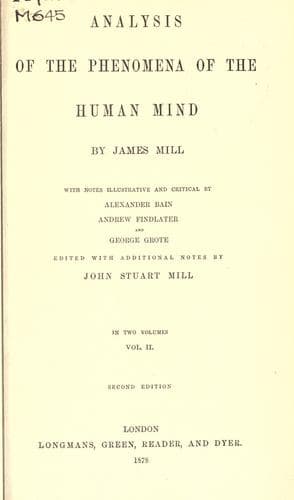
Analysis of the Phenomena of the Human MindMill, James
PhilosophyPhilosophy
Analysis of the Phenomena of the Human Mind
Mill, James
Psychology
We have now then explored those states of Consciousness which we
call Belief in existences;--Belief in present existences; Belief in
past existences; and Belief in future existences. We have seen that,
in the most simple cases, Belief consists in sensation alone, or
ideas alone; in the more complicated cases, in sensation, ideas, and
association, combined; and in no case of belief has any other
ingredient been found.
In accounting for belief in present objects not acting on the
senses,--it appeared, that a certain anticipation of the future
entered, for so much, into this compound phenomenon; the explanation
of which part we were obliged to leave, till the {378} anticipation
of the future had undergone investigation. We have now seen that
this part, as well as the rest, consists of association. The whole,
therefore, of this case of belief, is now resolved into association.
Mr. Locke, whose expositions of any of our mental phenomena are
almost always instructive, even when they stop short of being
complete, has given the above account of belief precisely, in one
remarkable and very extensive class of cases; those in which the
belief is unfounded; which he denominates prejudices.
"There is," he says,[13*] "scarce any one that does not observe
something that seems odd to him, and is in itself really extravagant
in the opinions, reasonings, and actions, of other men.
[Mill's footnote 13: Essay on the Human Understanding, B. II., Ch.
33.]
"This sort of unreasonableness is usually imputed to education and
prejudice; and for the most part truly enough; though that reaches
not the bottom of the disease, nor shews distinctly enough whence it
rises, or wherein it lies.
"Education is often rightly assigned for the cause; and prejudice is
a good general name for the thing itself; but yet, I think, he ought
to look a little farther, who would trace this sort of madness to
the root it springs from, and so explain it, as to shew whence this
flaw has its original in very sober and rational minds, and wherein
it consists."
Mr. Locke affords the explanation, which he thought necessary to be
given, and proceeds as follows.
"Some of our ideas have a natural correspondence and connexion one
with another. It is the office, and {379} excellence, of our reason,
to trace these; and hold them together in that union and
correspondence, which is founded in their peculiar beings.
"Besides this, there is another connexion of ideas, wholly owing to
chance or custom. Ideas, that in themselves are not at all of kin,
come to be so united in some men's minds, that it is very hard to
separate them. They always keep in company; and the one no sooner at
any time comes into the understanding, but its associate appears
with it. And if they are more than two which are thus united, the
whole gang, always inseparable, shew themselves together.
Public-domain text, read in full here on John Shaqi.
Reviews
Reviews
No reviews yet
Be the first to share your thoughts on this work.
Elsewhere in the archive
Join the Discussion
Join the discussion
Sign in to leave a comment or review.
Sign InorCreate an account