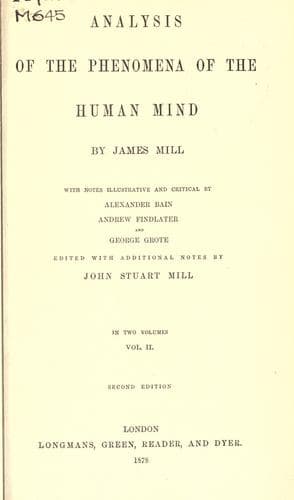
Analysis of the Phenomena of the Human MindMill, James
PhilosophyPhilosophy
Analysis of the Phenomena of the Human Mind
Mill, James
Psychology
When we begin, however, to look at the second of these foundations
more closely, it soon appears, that it is not in reality distinct
from the first. For what is testimony? It is itself an event. When
we believe any thing, therefore, in consequence of testimony, we
only believe one event in consequence of another. But this is the
general account of our belief in events. It is the union of the
ideas, of an antecedent, and a consequent, by a strong association.
I believe it is one o'clock. Why? I have just heard the clock
strike. _Striking of the clock_, antecedent; _one o'clock_,
consequent; the _second_ closely associated with the _first_. The
striking of the clock is in fact a species of testimony. What does
it testify? Not one event, but an infinite number of events, of
which the term "one o'clock" is the name. At every instant in the
course of the day, a number of events are taking place, some known
to us, some unknown. The term one o'clock, is the name of those
which take place at a particular point of the diurnal revolution. I
believe in them all upon the testimony of the clock. Why? From
experience;--every one would directly and {383} truly reply. I have
found the events constantly, or at least very regularly, conjoined.
From junction of the events, junction of the ideas; in other words,
belief.
If proof, only, were wanted, this would suffice. For the purpose,
however, of instruction, tuition, training, a more minute
developement of this important case of belief seems too useful to be
dispensed with, notwithstanding the tediousness which so many
repetitions of the same process are too likely to produce.
The watchman calling the hour, is a case of human testimony. That
the account of our belief, in this case, is precisely the same as
that in the case of the striking of the clock, it is wholly
unnecessary to prove. But if our reliance on testimony in one case
is pure experience, it may reasonably be inferred that it is so in
all.
The forms of expression, which we apply to this case of belief, are
very misleading. We say, "we believe a man," or, "we believe his
testimony." "We attach belief to the man," or, "to his testimony."
In these expressions, the name belief is applied to the wrong event;
to the antecedent, instead of the consequent. What we mean to say
is, that we believe the consequent, the thing testified, not the
antecedent, the speaking of the words. The words the man uses, are,
to us, sensations: belief that he uses the words, is not what is
meant by belief in his testimony. The same form of expression is
perfectly absurd, when applied to other cases. We never say that we
believe the flame of the candle, or we attach belief to the flame of
the candle, when we mean to state the belief, that a finger will be
burnt if it is put into the flame; {384} we never say we believe the
spark, when we mean to express our belief of an explosion when the
spark falls upon the gunpowder.
Public-domain text, read in full here on John Shaqi.
Reviews
Reviews
No reviews yet
Be the first to share your thoughts on this work.
Elsewhere in the archive
Join the Discussion
Join the discussion
Sign in to leave a comment or review.
Sign InorCreate an account