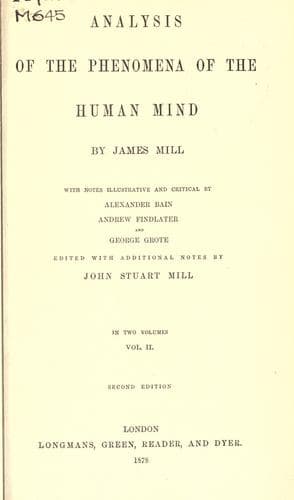
Analysis of the Phenomena of the Human MindMill, James
PhilosophyPhilosophy
Analysis of the Phenomena of the Human Mind
Mill, James
Psychology
The only question, then, is, in what manner the words of the
testifier, the antecedent, come to be so united with the idea of the
thing testified, as to constitute belief. And surely there is no
difficulty here, either in conceiving, or admitting the process.
Words call up ideas by association, solely. There is no natural
connexion between them. The manner in which words are applied to
events, I know most intimately by my own experience. I am
constantly, and, from the first moment I could use them, have
constantly been, employing words in exact conformity with events.
Cases occur in which I do not, but they are few in comparison with
those in which I do. It has been justly remarked, that the greatest
of liars speak truth a thousand times for once that they utter
falsehood. The connexion between the use of words, and the idea of
conformable existence, is, of course, established into one of the
strongest associations of the human mind. In other words, belief, in
consequence of testimony, is, strictly, a case of association. That
we interpret other men's actions by our own, no one doubts; and that
we do so entirely by association has already been proved.
In accounting for belief in past existences where it is not memory,
we have found that it is resolvable into belief in testimony, and in
the uniformity of the laws of nature; and the explanation of this we
postponed till the cases of belief in testimony, and in the
uniformity of the laws of nature, should be expounded. A few words
will now suffice to connect the {385} explanations formerly given
with those which have now been presented.
The two cases, as we have seen, resolve themselves into one; as
belief in testimony is but a case of the anticipation of the future
from the past; and belief in the uniformity of the laws of nature is
but another name for the same thing.
I believe the event called the fire of London, upon testimony.
I believe that the stranger who now passes before my window, had a
father and mother, was once an infant, then a boy, next a youth,
then a man, and that he has been nourished by food from his birth;
all this, from my belief in the uniformity of the laws of nature.
After the preceding developments, it is surely unnecessary to be
minute in the analysis of these instances. I have had experience, of
a constant series of antecedents and consequents, in the life of
man; generation, birth, childhood, and so on; as I have had of pain
from putting my finger in the flame. A corresponding association is
formed. If the sight of a stranger calls up the idea of his origin
and progress to manhood, the ordinary train of antecedents and
consequents is called up; nor is it possible for me to prevent it.
The association is indissoluble, and is one of the cases classed
under the name of Belief.
Public-domain text, read in full here on John Shaqi.
Reviews
Reviews
No reviews yet
Be the first to share your thoughts on this work.
Elsewhere in the archive
Join the Discussion
Join the discussion
Sign in to leave a comment or review.
Sign InorCreate an account