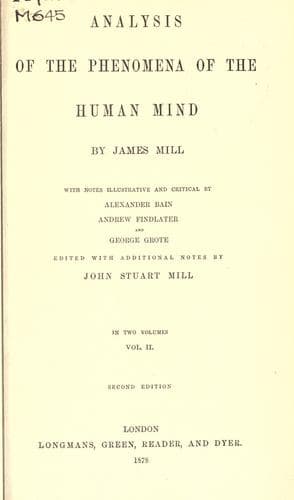
Analysis of the Phenomena of the Human MindMill, James
PhilosophyPhilosophy
Analysis of the Phenomena of the Human Mind
Mill, James
Psychology
{26} It is not so easy, in the case of this, as of some of the other
senses, to conceive ourselves as having this class of feelings and
no other. Antecedent to the sensation of taste, there is generally
some motion of the mouth, by which the object and the organ are
brought into the proper position and state. The sensation can hardly
be thought of without thinking of this motion, that is, of other
feelings. Besides, the organ of taste is also the organ of another
sense. The organ of taste has the sense of touch, and most objects
of taste are objects of touch. Sensations of touch, therefore, are
intimately blended with those of taste.
By a little pains, however, any one may conceive the sensations of
tasting, while he conceives his other organs to remain in a
perfectly inactive state, and himself as nothing but a passive
recipient of one taste after another. If he conceives a mere train
of those sensations, perfectly unmixed with any other feeling, he
will have the conception of a being made up of tastes; a thread of
consciousness, which maybe called mere taste; a life which is merely
taste.
The language employed about this sense is not less faulty, than that
employed about the other senses, which we have already surveyed.
There is no proper name for the organ. The word Mouth, which we are
often obliged to employ for that purpose, is the name of this organ
and a great deal more.
There is no proper name for the object. We are obliged to call it,
that which has taste. The word flavour is used to denote that
quality, which is more peculiarly the object of taste, in certain
articles of food; and sometimes we borrow the word sapidity, {27}
from the Latin, to answer the same purpose more extensively.
The word taste is a name for the sensation. We generally call the
feeling, which is the point of consciousness in this case, by the
name taste. Thus we say one taste is pleasant, another unpleasant;
and nothing is pleasant or unpleasant but a feeling.
The word taste is also a name for the object, as when we say, that
any thing has taste.
It is further employed as a name of the organ. As we are said to
perceive qualities by the eye, the ear, and the touch; so we are
said to perceive them by the taste.
In the phrase, sense of taste, there is the same complexity of
meaning as we have observed in the corresponding phrase in the case
of the other senses. In this phrase, taste expresses all the leading
particulars; the organ, the object, and the sensation, together with
the order of position in the two first, and the order of constant
sequence in the last.[8]
[Editor's footnote 8: The statement that "taste" is sometimes
employed as a name of the organ, seems to me, like the similar
statements respecting the names of our other senses,
disputable.--_Ed._]
{28} SECTION V.
TOUCH.
In discoursing about the ORGAN, the SENSATIONS, and the OBJECTS, of
touch, more vagueness has been admitted, than in the case of any of
the other senses.
Public-domain text, read in full here on John Shaqi.
Reviews
Reviews
No reviews yet
Be the first to share your thoughts on this work.
Join the Discussion
Join the discussion
Sign in to leave a comment or review.
Sign InorCreate an account