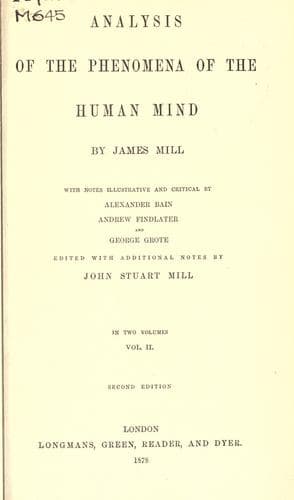
Analysis of the Phenomena of the Human MindMill, James
PhilosophyPhilosophy
Analysis of the Phenomena of the Human Mind
Mill, James
Psychology
The sensations of heat and cold offer this advantage,--that being
often felt without the accompaniment of {30} any thing visible or
extended, which can be called an object, they can be more distinctly
conceived as simple feelings, than most of our other sensations.[10]
They are feelings very different from the ordinary sensations of
touch; and possibly the only reason for classing them with those
sensations was, that the organ of them, like that of touch, is
diffused over the whole body. We know not that the nerves
appropriated to the sensations of heat and cold are the same with
those which have the sensation of touch. If they be the same, they
must at any rate be affected in a very different manner.
[Bain's footnote 10: The sensations of heat and cold are, of all
sensations, the most _subjective_. The reason is that they are least
connected with definite muscular energies. The rise and fall of the
temperature of the surrounding air may induce sensations wholly
independent of our own movements; and to whatever extent such
independence exists, there is a corresponding absence of
objectivity. This independence, however, is still only partial, even
in the case of heat and cold; in a great number, perhaps a majority,
of instances, they depend upon our movements; as in changing our
position with reference to a fire, in our clothing, and so on. It is
the possibility of conceiving them in the pure subject character,
and apart from object relations, that constitutes them simple
feelings, in the acceptation of the text. Although not in an equal
degree, the same is true of sensations of hearing, on which the
author made a similar remark.--_B_].
To whatever class we may refer the sensations of heat and cold, in
their moderate degrees, it seems that good reasons may be given for
not ranking them with the sensations of touch, when they rise to the
degree of pain. All those acute feelings which attend the
disorganization, or tendency toward disorganization, {31} of the
several parts of our frame, seem entirely distinct from the feelings
of touch. Even in the case of cutting, or laceration, the mere touch
of the knife or other instrument is one feeling, the pain of the
cut, or laceration, another feeling, as much as, in the mouth, the
touch of the sugar is one feeling, the sweetness of it another.
As we shall offer reasons hereafter to show, that the feelings of
resistance, extension, and figure, are not feelings of touch, we
should endeavour to conceive what feeling it is which remains when
those feelings are taken away.
Public-domain text, read in full here on John Shaqi.
Reviews
Reviews
No reviews yet
Be the first to share your thoughts on this work.
Join the Discussion
Join the discussion
Sign in to leave a comment or review.
Sign InorCreate an account