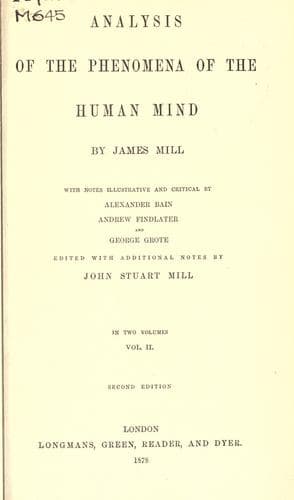
Analysis of the Phenomena of the Human Mind — John Shaqi
Analysis of the Phenomena of the Human MindMill, James
PhilosophyPhilosophy
Analysis of the Phenomena of the Human Mind
Mill, James
Psychology
When I say that I feel the table, there is a considerable complexity
of meaning. Dr. Reid, and his followers, maintain, that I have not
one point of {33} consciousness only, but two; that I feel the
sensation, and that I feel the table; that the sensation is one
thing, the feeling of the table another. Expositions which will be
given hereafter are necessary to the complete elucidation of what
takes place. But the explanations which have been already afforded
will enable us to state the facts with considerable clearness. In
what is called feeling the table, my organ of touch, and an object
of touch, in the appropriate position, are the antecedent; of this
antecedent, sensation is the consequent. The expression, "I feel the
table," includes both the antecedent and the consequent. It does not
mark the sensation alone; it marks the sensation, and, along with
the sensation, its antecedent, namely, the organ, and its object in
conjunction.
The phrase, sense of touch, or the word feeling, often synonymous,
has the same complexity of meaning, which we have observed in the
phrases, sense of hearing, sense of sight, and the rest of the
senses.
When I say that I touch, or have the sense of touch, I mean to say,
that I have a certain feeling, consequent upon a certain antecedent.
The phrase, therefore, _notes_ the sensation, and at the same time
_connotes_[4*] the following things: 1st, the organ; 2dly, {34} the
object of the organ; 3dly, the synchronous order of the organ and
object; 4thly, the successive order of the sensation; the
synchronous order being, as usual, the antecedent of the successive
order.[5*] [12]
[Mill's footnote 4: The use, which I shall make, of the term
_connotation_, needs to be explained. There is a large class of
words, which denote two things, both together; but the one perfectly
distinguishable from the other. Of these two things, also, it is
observable, that such words express the one, _primarily_, as it
were; the other, in a way which may be called _secondary_. Thus,
_white_, in the phrase _white horse_, denotes two things, the
colour, and the horse; but it denotes the colour _primarily_, the
horse _secondarily_. We shall find it very convenient, to say,
therefore, that it _notes_ the primary, _connotes_ the secondary,
signification.--(_Author's Note_.) [Reasons will be assigned further
on, why the words _to connote_ and _connotation_ had better be
employed, not as here indicated, but in a different and more special
sense.--ED.]]
Public-domain text, read in full here on John Shaqi.
Reviews
Reviews
No reviews yet
Be the first to share your thoughts on this work.
Join the Discussion
Join the discussion
Sign in to leave a comment or review.
Sign InorCreate an account