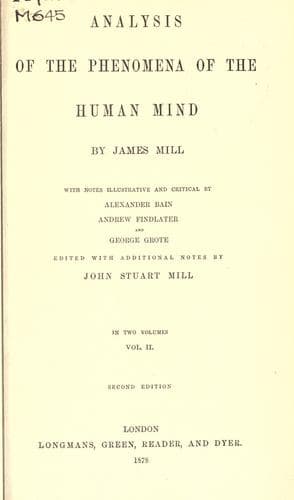
Analysis of the Phenomena of the Human Mind — John Shaqi
Analysis of the Phenomena of the Human MindMill, James
PhilosophyPhilosophy
Analysis of the Phenomena of the Human Mind
Mill, James
Psychology
That we have sensations in parts of the body suffering, or
approaching to, disorganization, does not require illustration. The
disorganizations of which we speak proceed sometimes from external,
sometimes from internal, causes. Lacerations, cuts, bruises,
burnings, poisonings, are of the former kind; inflammation, and
other diseases in the parts, are the latter.
These sensations are specifically different from those classed under
the several heads of sense. The feelings themselves, if attended to,
are evidence of this. In the next place, they have neither organ,
nor object, in the sense in which those latter feelings have them.
We do not talk of an organ of burning; an organ of pain; nor do we
talk of an object of any of them; we do not say the object of a cut,
the object of an ache, the object of a sore.
Most of those sensations are of the painful kind; though some are
otherwise. Some slight, or locally minute inflammations, produce a
sensation called itching, which is far from disagreeable, as appears
from the desire to scratch, which excites it.[13]
[Editor's footnote 13: The author, in this passage, uses the word
itching out of its ordinary sense; making it denote the pleasant
sensation accompanying the relief by scratching, instead of the
slightly painful, and sometimes highly irritating, sensation which
the scratching relieves.--_Ed._]
{38} The scratching, which excites the pleasure of itching, is a
species of friction, and friction, in most parts of the body,
excites a sensation very different from the mere sense of touching
or the simple feeling of the object. The tickling of the feather in
the nose, for example, is very different from the mere feeling of
the feather in touch. In some parts of the body the most intense
sensations are produced by friction.
There is difficulty in classing those sensations. They are not the
same with those of any of the five senses: and they are not the same
with those which rise from any tendency to disorganization in the
parts of the body to which they are referred. Great accuracy,
however, in the classification of the sensations, is not essential
to that acquaintance with them, which is requisite for the
subsequent parts of this inquiry. It will suffice for our purpose,
if the reader so far attend to them, as to be secure from the danger
of overlooking or mistaking them, where a distinct consideration of
them is necessary for developing any of the complicated phenomena in
which they are concerned.[14]
[Bain's footnote 14: _Organic Sensibilities_.--The author did well
to signalize these sensibilities, so powerful in their influence on
human life. They are not confined to the side of pain. The same
organs whose disorganization is connected with pain, are, in their
healthy and vigorous working, more or less connected with pleasure.
This is true not merely of the digestive functions, but of the
respiration, the circulation, and others.
Public-domain text, read in full here on John Shaqi.
Reviews
Reviews
No reviews yet
Be the first to share your thoughts on this work.
Join the Discussion
Join the discussion
Sign in to leave a comment or review.
Sign InorCreate an account