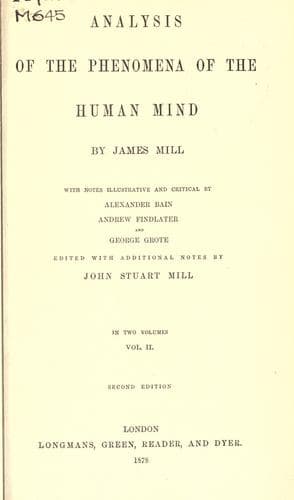
Analysis of the Phenomena of the Human MindMill, James
PhilosophyPhilosophy
Analysis of the Phenomena of the Human Mind
Mill, James
Psychology
It is, therefore, scarcely possible to advance even a
single step, in intellectual physics, without the necessity of
performing some sort of analysis, by which we reduce to simpler
elements some complex feeling that seems to us virtually to involve
them."
These explanations define and characterize the task which was
proposed to himself by the author of the {x} present treatise, and
which he concisely expressed by naming his work an Analysis of the
Phenomena of the Human Mind. It is an attempt to reach the simplest
elements which by their combination generate the manifold complexity
of our mental states, and to assign the laws of those elements, and
the elementary laws of their combination, from which laws, the
subordinate ones which govern the compound states are consequences
and corollaries.
The conception of the problem did not, of course, originate with the
author; he merely applied to mental science the idea of scientific
inquiry which had been matured by the successful pursuit, for many
generations, of the knowledge of external nature. Even in the
particular path by which he endeavoured to reach the end, he had
eminent precursors. The analytic study of the facts of the human
mind began with Aristotle; it was first carried to a considerable
height by Hobbes and Locke, who are the real founders of that view
of the Mind which regards the greater part of its intellectual
structure as having been built up by Experience. These three
philosophers have all left their names identified with the great
fundamental law of Association of Ideas; yet none of them saw far
enough to perceive that it is through this law that Experience
operates in moulding our thoughts and forming our thinking powers.
Dr. Hartley was the man of genius who first clearly {xi} discerned
that this is the key to the explanation of the more complex mental
phenomena, though he, too, was indebted for the original conjecture
to another wise forgotten thinker, Mr. Gay. Dr. Hartley's treatise
("Observations on Man") goes over the whole field of the mental
phenomena, both intellectual and emotional, and points out the way
in which, as he thinks, sensations, ideas of sensation, and
association, generate and account for the principal complications of
our mental nature. If this doctrine is destined to be accepted as,
in the main, the true theory of the Mind, to Hartley will always
belong the glory of having originated it. But his book made scarcely
any impression upon the thought of his age. He incumbered his theory
of Association with a premature hypothesis respecting the physical
mechanism of sensation and thought; and even had he not done so, his
mode of exposition was little calculated to make any converts but
such as were capable of working out the system for themselves from a
few hints. His book is made up of hints rather than of proofs. It is
like the production of a thinker who has carried his doctrines so
long in his mind without communicating them, that he has become
Public-domain text, read in full here on John Shaqi.
Reviews
Reviews
No reviews yet
Be the first to share your thoughts on this work.
Join the Discussion
Join the discussion
Sign in to leave a comment or review.
Sign InorCreate an account