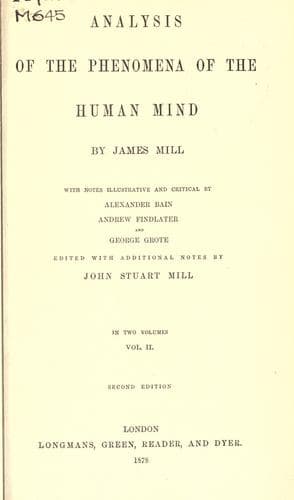
Analysis of the Phenomena of the Human MindMill, James
PhilosophyPhilosophy
Analysis of the Phenomena of the Human Mind
Mill, James
Psychology
It is not, however, necessary, in tracing the simple feelings which
enter into the more complex states of consciousness, to dwell upon
the obscurer classes of our inward sensations; because it is only in
a very general way that we can make use of them, in expounding the
more mysterious phenomena. Having never acquired the habit of
attending to them, and having, by the habit of inattention, lost the
power of remarking them, except in their general results, we {62}
can do little more than satisfy ourselves of the cases in which they
enter for more or less of the effect.
We have now considered what it is to have sensations, in the simple,
uncompounded cases; and what it is to have the secondary feelings,
which are the consequences of those sensations, and which we
consider as their copies, images, or representatives. If the
illustrations I have employed have enabled my reader to familiarize
himself with this part of his constitution, he has made great
progress towards the solution of all that appears intricate in the
phenomena of the human mind. He has acquainted himself with the two
primary states of consciousness; the varieties of which are very
numerous; and the possible combinations of which are capable of
composing a train of states of consciousness, the diversities of
which transcend the limits of computation.[23] [24]
[Bain's footnote 23: _The Sensation and the Idea compared_.--Great
importance, in every way, attaches to the points of agreement and of
difference of the Sensation and of the Idea. By the Sensation, we
mean the whole state of consciousness, under an actual or present
impression of sense, as in looking at the moon, in listening to
music, in tasting wine. By the Idea is meant the state of mind that
remains after the sensible agent is withdrawn, or that may be
afterwards recovered by the force of recollection.
1. For many purposes the sensation and the idea are identical. They
are compared to original and copy, which, although not in all
respects of equal value, can often answer the same ends. A perfect
recollection of a process that we wish to repeat, is as good as
actually seeing it. For all purposes of knowledge, and of practical
guidance, a faithful remembrance is equal to the real presence. So,
as regards the emotional ideas, or the recollection of states of
pleasure and of pain, which {63} prompt our voluntary actions, in
pursuit and in avoidance, the memory operates in the same way as the
original fact, allowance being made for difference of degree. A
pleasing melody induces us to listen to it, and to crave for its
repetition; the after recollection of it, also moves us to hear it
again. If we find ourselves in the midst of distracting noises, we
are impelled to escape; the mere remembrance, at an after time, has
the same influence on the will.
Public-domain text, read in full here on John Shaqi.
Reviews
Reviews
No reviews yet
Be the first to share your thoughts on this work.
Elsewhere in the archive
Join the Discussion
Join the discussion
Sign in to leave a comment or review.
Sign InorCreate an account