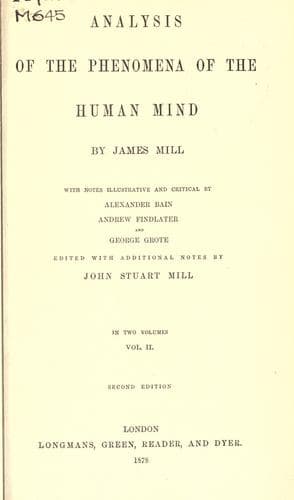
Analysis of the Phenomena of the Human MindMill, James
PhilosophyPhilosophy
Analysis of the Phenomena of the Human Mind
Mill, James
Psychology
2. It is highly probable, if not certain, that the same nervous
tracks of the brain are actuated during the sensation, and during
the idea, with difference of degree corresponding to the difference
of vivacity or intensity of the actual and remembered states.
Of the points wherein the Sensation and the Idea are found to
differ, the most obvious is their degree of intensity. We are able
to maintain in idea, the state of mind corresponding to the sight of
the sun, the sound of a bell, or the smell of a rose, but we are
conscious of a great inferiority in the degree or vividness of the
state. The bright luminosity of the original sun turns into a feeble
effect, without dazzle or excitement. The thrill of a fine musical
air cannot be sustained by the mere memory of it, even in the
freshness of the immediately succeeding moment. A certain pleasing
remembrance attaches to a good dinner, but how far below the
original! Moreover, in a complicated object of sense, a great many
of the parts and lineaments drop entirely out of view. Memory is
unequal to retaining, without long familiarity and practice, the
exact picture of a landscape, a building, or an interior. The
difference in the fulness of the idea, as compared with the
sensation, is no less remarkable than the difference of vivacity or
intensity. This inferiority in the idea as compared with the
actuality is of very various amount; being in some cases very great,
and in others very slight. The difference is in proportion to the
mind's power of retentiveness, a power varying according to several
circumstances or conditions, which have to be distinctly enunciated
by the Psychologist. For example, it is well known, that frequency
of repetition enables the idea to {64} grow in vivacity and in
fulness, and to approximate in those respects to the original. It is
also known, that some minds are by nature retentive, and, by a small
number of repetitions, gain the point that others reach only by a
greater number.
Now, that the vivacity and fulness of a remembered idea should
constitute the exact measure of the mind's retentiveness in that
particular instance, is a thing of course. There is no other measure
of retentiveness but the power of reproducing in idea, what has been
before us, in actuality, or as sensation; and the greater the
approach of the idea to the original sensation, the better is the
retaining faculty.
There is an apparent exception to this general principle. The memory
of the same idea, or the same feeling, in the same person, may be at
one time full and vivid, and at another time meagre and faint. In
particular moments, we may recall former experiences with especial
force, as if there were something that co-operated with the proper
force of retentiveness. What, then, are these additional or
concurring forces? Hume recognises the influence of disease in
giving preternatural intensity to ideas.
Public-domain text, read in full here on John Shaqi.
Reviews
Reviews
No reviews yet
Be the first to share your thoughts on this work.
Elsewhere in the archive
Join the Discussion
Join the discussion
Sign in to leave a comment or review.
Sign InorCreate an account