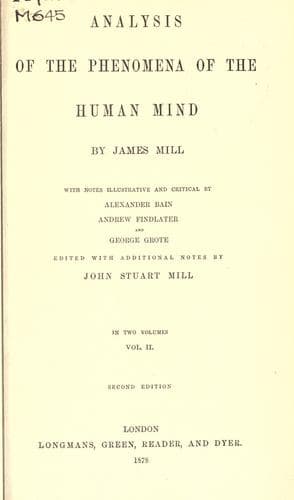
Analysis of the Phenomena of the Human MindMill, James
PhilosophyPhilosophy
Analysis of the Phenomena of the Human Mind
Mill, James
Psychology
1. There being, in Sensation, the concurrence of a series of
physical or physiological facts with a mental fact, the name may be
inadvertently employed to express the physical, as well {66} as the
mental element, or at all events to include the physical part as
well as the mental.
The change made on the retina by light, and the nervous influences
traversing the brain, may very readily be considered as entering
into the phenomenon of sensation. This, however, is an impropriety.
The proper use of "Sensation" is to signify the mental fact, to the
exclusion of all the physical processes essential to its production.
2. In ordinary Sensation, as in looking round a room, there is a
double consciousness,--objective and subjective. In the objective
consciousness, we are affected with the qualities named magnitude,
distance, form, colour, &c.; these are called object properties,
properties of the external and extended universe. In the subject
consciousness, we are alive to states of pleasure or of pain, which
may go along with the other. We do not usually exist in both modes
at one instant; we pass out of one into the other. Now the word
Sensation covers both, although, to the object consciousness,
"Perception" is more strictly applicable; and in contrast to
Perception, Sensation would mean the subjective consciousness, the
moments when we relapse from the object attitude and become
subjective or self-conscious, or alive to pleasure and pain. When
the mind is in the object phase, it is neutral or indifferent as
respects enjoyment.
3. In Sensation, a distinction may be drawn between the present
effect upon the mind, or the impression that would arise if the
outward agent had operated for the first time, and the total of the
past impressions of the same agent, which by its repetition are
recalled to fuse with the present effect. The present view of the
moon reinstates the sum total of the previous views held by memory,
and is not what we should experience if we saw the moon for the
first time. Now, if the recall of the previous impressions, or of
the joint and iterated idea, be considered an addition made by the
Intellect, being dependent on the retentive power of the mind,
Sensation, as opposed to Intellect, would mean the force of the
present impression and nothing more; or the difference between the
{67} vividness of reality, and the inferior vividness of
recollection. What we can retain when we shut our eyes would
represent the force of our intelligence; the additional intensity
when we resume our gaze, would represent the power of sensation or
the actual experience.
Public-domain text, read in full here on John Shaqi.
Reviews
Reviews
No reviews yet
Be the first to share your thoughts on this work.
Elsewhere in the archive
Join the Discussion
Join the discussion
Sign in to leave a comment or review.
Sign InorCreate an account