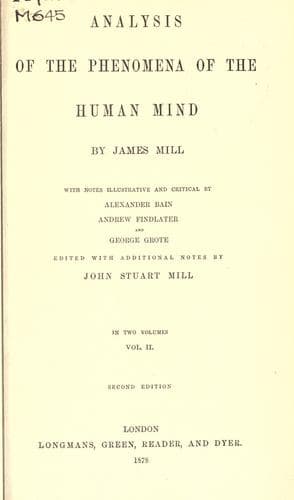
Analysis of the Phenomena of the Human MindMill, James
PhilosophyPhilosophy
Analysis of the Phenomena of the Human Mind
Mill, James
Psychology
This distinction suggests an important remark as to the whole nature
of Sensation, namely, that there can hardly be such a thing as pure
Sensation, meaning Sensation without any admixture of the Intellect.
We may attribute this purity to the earliest impressions made upon
the mind, but not to anything known in the experience of the adult.
This mixture of Intellect with Sense is not confined to
Retentiveness; the other intellectual functions, Discrimination and
perception of Agreement, are inseparable from the exercise of the
senses. We cannot have a sensation without a feeling of difference;
warmth is a transition from cold, and a conscious discrimination of
the two facts. So, whenever we repeat a sensation, we have the
consciousness of the repetition, or agreement. Were not these modes
of consciousness present, we should have no sensation, indeed no
consciousness. There is thus no hard line between sense and
intellect. The question as to the origin of our Ideas in Sense is
not a real question, until we explain what we mean by Sense, and
make allowance for this unavoidable participation of Intellect in
sensation.
4. Sensation is commonly used to employ the whole of our primary
feelings and susceptibilities, as opposed to the Emotions which are
secondary or derived. It thus confounds together two different sides
of our susceptibility, the active and the passive; the feelings
arising in connection with our exertion of inward force or energy,
and those arising under impressions from external things. Both are
primary states of consciousness; they are alike dependent on
modifications of our sensitive tissues. But, between the two, there
is a contrast, wide, deep, and fundamental, completely missed by the
older Psychologists, to the detriment of their handling of such
vital questions as the origin of knowledge, and the perception of a
material world. The name Sensation, pointing immediately to {68} the
operation of the five senses, gave the slip to the feelings of
energy, or brought them in partially and inadequately. Yet it is the
only name we have for the primary susceptibilities of the organism
including both movement and passive sensibility.--_B._]
[Editor's footnote 24: A question which, as far as I know, has been
passed over by psychologists, but which ought not to be left
unanswered, is this: Can we have ideas of ideas? We have sensations,
and we have copies of these sensations, called ideas of them: can we
also have copies of these copies, constituting a second order of
ideas, two removes instead of one from sensation?
Public-domain text, read in full here on John Shaqi.
Reviews
Reviews
No reviews yet
Be the first to share your thoughts on this work.
Elsewhere in the archive
Join the Discussion
Join the discussion
Sign in to leave a comment or review.
Sign InorCreate an account