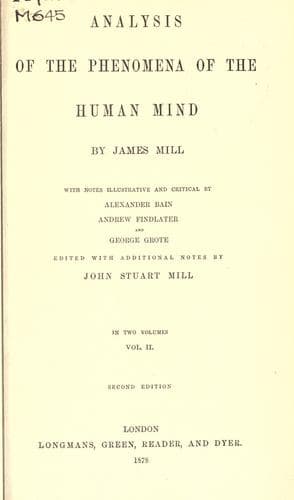
Analysis of the Phenomena of the Human MindMill, James
PhilosophyPhilosophy
Analysis of the Phenomena of the Human Mind
Mill, James
Psychology
It so happens, that, of the objects from which we derive the
greatest part of our sensations, most of those which are observed
synchronically, are frequently observed synchronically; most of
those which are observed successively, are frequently observed
successively. In other words, most of our synchronical sensations,
have been frequently synchronical; most of our successive
sensations, have been frequently successive. Thus, most of our
synchronical sensations are derived from the objects around us, the
objects which we have the most frequent occasion to hear and see;
the members of our family; the furniture of our houses; our food;
the instruments of {78} our occupations or amusements. In like
manner, of those sensations which we have had in succession, we have
had the greatest number repeatedly in succession; the sight of fire,
and its warmth; the touch of snow, and its cold; the sight of food,
and its taste.
Thus much with regard to the order of SENSATIONS; next with regard
to the order of IDEAS.
As ideas are not derived from objects, we should not expect their
order to be derived from the order of objects; but as they are
derived from sensations, we might by analogy expect, that they would
derive their order from that of the sensations; and this to a great
extent is the case.
Our ideas spring up, or exist, in the order in which the sensations
existed, of which they are the copies.
This is the general law of the "Association of Ideas"; by which
term, let it be remembered, nothing is here meant to be expressed,
but the order of occurrence.
In this law, the following things are to be carefully observed.
1. Of those sensations which occurred synchronically, the ideas also
spring up synchronically. I have seen a violin, and heard the tones
of the violin, synchronically. If I think of the tones of the
violin, the visible appearance of the violin at the same time occurs
to me. I have seen the sun, and the sky in which it is placed,
synchronically. If I think of the one, I think of the other at the
same time.
One of the cases of synchronical sensation, which deserves the most
particular attention, is, that of the several sensations derived
from one and the same {79} object; a stone, for example, a flower, a
table, a chair, a horse, a man.
From a stone I have had, synchronically, the sensation of colour,
the sensation of hardness, the sensations of shape, and size, the
sensation of weight. When the idea of one of these sensations
occurs, the ideas of all of them occur.[26] They exist in my mind
synchronically; and their synchronical existence is called the idea
of the stone; which, it is thus plain, is not a single idea, but a
number of ideas in a particular state of combination.
Public-domain text, read in full here on John Shaqi.
Reviews
Reviews
No reviews yet
Be the first to share your thoughts on this work.
Elsewhere in the archive
Join the Discussion
Join the discussion
Sign in to leave a comment or review.
Sign InorCreate an account