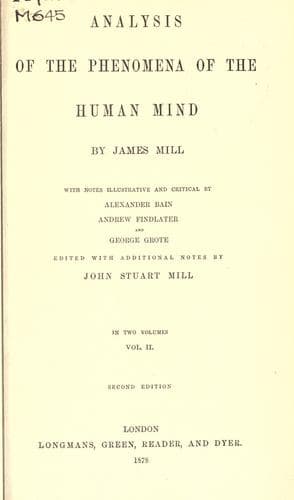
Analysis of the Phenomena of the Human MindMill, James
PhilosophyPhilosophy
Analysis of the Phenomena of the Human Mind
Mill, James
Psychology
[Bain's footnote 26: This must be qualified by the fact that the
same individual sensation may be found in many groupings, and
therefore may not bring up any one aggregate or concrete object in
particular. The colour, white, is seen in conjunction with many
different shapes, magnitudes, and weight; consequently it does not
suggest a specific shape or magnitude. In such a case, the recall
may be very various according to circumstances; some individual may
have a greater prominence than the rest, and be singled out on that
ground; two or three may be brought to view; or a still greater
number may be revived.
This is an important limitation of the working of the associating
principle. An individual thing is not restored, as a matter of
course, unless the link of connexion points to it alone; as is often
effected by a plurality of bonds. Thus a musical air is not
suggested until as many notes are heard as to distinguish it from
every other known air.--_B._]
Thus, again, I have smelt a rose, and looked at, and handled a rose,
synchronically; accordingly the name rose suggests to me all those
ideas synchronically; and this combination of those simple ideas is
called my idea of the rose.
My idea of an animal is still more complex. The {80} word thrush,
for example, not only suggests an idea of a particular colour and
shape, and size, but of song, and flight, and nestling, and eggs,
and callow young, and others.
My idea of a man is the most complex of all; including not only
colour, and shape, and voice, but the whole class of events in which
I have observed him either the agent or the patient.
2. As the ideas of the sensations which occurred synchronically,
rise synchronically, so the ideas of the sensations which occurred
successively, rise successively.
Of this important case of association, or of the successive order of
our ideas, many remarkable instances might be adduced. Of these none
seems better adapted to the learner than the repetition of any
passage, or words; the Lord's Prayer, for example, committed to
memory. In learning the passage, we repeat it; that is, we pronounce
the words, in successive order, from the beginning to the end. The
order of the sensations is successive. When we proceed to repeat the
passage, the ideas of the words also rise in succession, the
preceding always suggesting the succeeding, and no other. _Our_
suggests _Father_, _Father_ suggests _which_, _which_ suggests
_art_; and so on, to the end. How remarkably this is the case, any
one may convince himself, by trying to repeat backwards, even a
passage with which he is as familiar as the Lord's Prayer. The case
is the same with numbers. A man can go on with the numbers in the
progressive order, one, two, three, &c. scarcely thinking of his
act; and though it is possible for him to repeat them backward,
because he is accustomed {81} to subtraction of numbers, he cannot
do so without an effort.
Public-domain text, read in full here on John Shaqi.
Reviews
Reviews
No reviews yet
Be the first to share your thoughts on this work.
Elsewhere in the archive
Join the Discussion
Join the discussion
Sign in to leave a comment or review.
Sign InorCreate an account