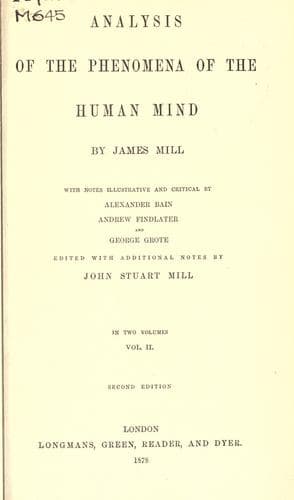
Analysis of the Phenomena of the Human MindMill, James
PhilosophyPhilosophy
Analysis of the Phenomena of the Human Mind
Mill, James
Psychology
[Editor's footnote 28: If it be admitted that in the three cases
here specified the word vividness, as applied to our impressions,
has a definite meaning, it seems to follow that this meaning may be
extended in the way of analogy, to other cases than these. There
are, for example, sensations which differ from some other sensations
like fainter feelings of the same kind, in much the same manner as
the idea of a sensation differs from the sensation itself: and we
may, by extension, call these sensations less vivid. Again, one idea
may differ from another idea in the same sort of way in which the
idea of a sensation had long ago differs from that of a similar
sensation received recently: that is, it is a more faded copy--its
colours and its outlines are more effaced: this idea may fairly be
said to be less vivid than the other.
The author himself, a few pages farther on, speaks of some complex
ideas as being more "obscure" than others, merely on account of
their greater complexity. Obscurity, indeed, in this case, means a
different quality from the absence of vividness, but a quality fully
as indefinite.
Mr. Bain, whose view of the subject will be found further on, draws
a fundamental distinction (already indicated in a former note)
between the attributes which belong to a sensation regarded in an
intellectual point of view, as a portion of our knowledge, and those
which belong to the element of Feeling contained in it; Feeling
being here taken in the narrower acceptation of the word, that in
which Feeling is opposed to Intellect or Thought. To sensations in
their intellectual aspect Mr. Bain considers the term vividness to
be inapplicable: they can only be distinct or indistinct. He
reserves the word vividness to express the degree of intensity of
the sensation, considered in what may be called its emotional
aspect, whether of pleasure, of pain, or of mere excitement.
Whether we accept this restriction or not, it is in any case
certain, that the property of producing a strong and durable
association without the aid of repetition, belongs principally to
our pleasures and pains. The more intense the pain or pleasure, the
more promptly and powerfully does it associate itself with its
accompanying circumstances, even with those which are only
accidentally present. In the cases mentioned in the text, a single
occurrence of the painful sensation is sufficient to produce an
association, which neither time can wear out nor
counter-associations dissolve, between the idea of the pain and the
ideas of the sensations which casually accompanied it in that one
instance, however intrinsically indifferent these may be.--_Ed._]
Public-domain text, read in full here on John Shaqi.
Reviews
Reviews
No reviews yet
Be the first to share your thoughts on this work.
Elsewhere in the archive
Join the Discussion
Join the discussion
Sign in to leave a comment or review.
Sign InorCreate an account