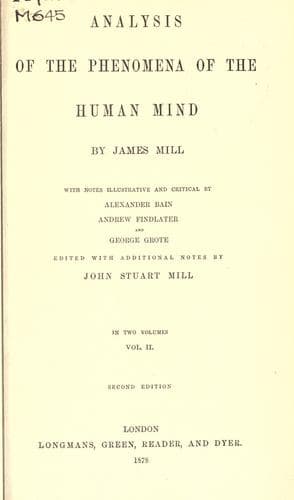
Analysis of the Phenomena of the Human MindMill, James
PhilosophyPhilosophy
Analysis of the Phenomena of the Human Mind
Mill, James
Psychology
In general, we convey not a very precise meaning, {84} when we speak
of the vividness of sensations and ideas. We may be understood when
we say that, generally speaking, the sensation is more vivid than
the idea; or the primary, than the secondary feeling; though in
dreams, and in delirium, ideas are mistaken for sensations. But when
we say that one sensation is more vivid than another, there is much
more uncertainty. We can distinguish those sensations which are
pleasurable, and those which are painful, from such as are not so;
and when we call the pleasurable and painful more vivid, than those
which are not so, we speak intelligibly. We can also distinguish
degrees of pleasure, and of pain; and when we call the sensation of
the higher degree more vivid than the sensation of the lower degree,
we may again be considered as expressing a meaning tolerably
precise.
In calling one IDEA more vivid than another, if we confine the
appellation to the ideas of such SENSATIONS as may with precision be
called more or less vivid; the sensations of pleasure and pain, in
their various degrees, compared with sensations which we do not call
either pleasurable or painful; our language will still have a
certain degree of precision. But what is the meaning which I annex
to my words, when I say, that my idea of the taste of the pine-apple
which I tasted yesterday is vivid; my idea of the taste of the
foreign fruit which I never tasted but once in early life, is not
vivid? If I mean that I can more certainly distinguish the more
recent, than the more distant sensation, there is still some
precision in my language; because it seems true of all my senses,
that if I compare a distant sensation with a present, I am less sure
of its being or not being a repetition of the same, than {85} if I
compare a recent sensation with a present one. Thus, if I yesterday
had a smell of a very peculiar kind, and compare it with a present
smell, I can judge more accurately of the agreement or disagreement
of the two sensations, than if I compared the present with one much
more remote. The same is the case with colours, with sounds, with
feelings of touch, and of resistance. It is therefore sufficiently
certain, that the idea of the more recent sensation affords the
means of a more accurate comparison, generally, than the idea of the
more remote sensation. And thus we have three cases of vividness, of
which we can speak with some precision: the case of sensations, as
compared with ideas; the case of pleasurable and painful sensations,
and their ideas, as compared with those which are not pleasurable or
painful; and the case of the more recent, compared with the more
remote.[28]
Public-domain text, read in full here on John Shaqi.
Reviews
Reviews
No reviews yet
Be the first to share your thoughts on this work.
Elsewhere in the archive
Join the Discussion
Join the discussion
Sign in to leave a comment or review.
Sign InorCreate an account