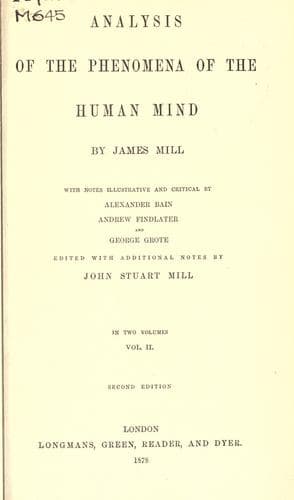
Analysis of the Phenomena of the Human MindMill, James
PhilosophyPhilosophy
Analysis of the Phenomena of the Human Mind
Mill, James
Psychology
When I lift my eyes from the paper on which I am writing, I see the
chairs, and tables, and walls of my room, each of its proper shape,
and at its proper {95} distance. I see, from my window, trees, and
meadows, and horses, and oxen, and distant hills. I see each of its
proper size, of its proper form, and at its proper distance; and
these particulars appear as immediate informations of the eye, as
the colours which I see by means of it.
Yet, philosophy has ascertained, that we derive nothing from the eye
whatever, but sensations of colour; that the idea of extension, in
which size, and form, and distance are included, is derived from
sensations, not in the eye, but in the muscular part of our frame.
How, then, is it, that we receive accurate information, by the eye,
of size, and shape, and distance? By association merely.[29]
[Bain's footnote 29: We derive through the eye (1) sensations of
light in its various degrees, and of colours and their shades; (2)
visible form and visible magnitude, together with their changes; and
also visible movements. The second group of feelings depends on the
movements of the eyes; and they are feelings of activity, or of
muscular expenditure. We have, besides, a certain internal muscular
sensibility to the alterations of the eye ball in adjusting for
distance--_B._]
The colours upon a body are different, according to its figure, its
distance, and its size. But the sensations of colour, and what we
may here, for brevity, call the sensations *of extension, of figure,
of distance, have been so often united, felt in conjunction, that
the sensation of the colour is never experienced without raising the
ideas of the extension, the figure, the distance, in such intimate
union with it, that they not only cannot be separated, but are
actually supposed to be seen. The sight, as it is called, of figure,
or {96} distance, appearing, as it does, a simple sensation, is in
reality a complex state of consciousness; a sequence, in which the
antecedent, a sensation of colour, and the consequent, a number of
ideas, are so closely combined by association, that they appear not
one idea, but one sensation.
Some persons, by the folly of those about them, in early life, have
formed associations between the sound of thunder, and danger to
their lives. They are accordingly in a state of agitation during a
thunder storm. The sound of the thunder calls up the idea of danger,
and no effort they can make, no reasoning they can use with
themselves, to show how small the chance that they will be harmed,
empowers them to dissolve the spell, to break the association, and
deliver themselves from the tormenting idea, while the sensation or
the expectation of it remains.
Public-domain text, read in full here on John Shaqi.
Reviews
Reviews
No reviews yet
Be the first to share your thoughts on this work.
Elsewhere in the archive
Join the Discussion
Join the discussion
Sign in to leave a comment or review.
Sign InorCreate an account