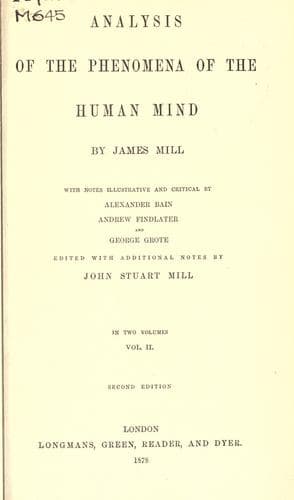
Analysis of the Phenomena of the Human MindMill, James
PhilosophyPhilosophy
Analysis of the Phenomena of the Human Mind
Mill, James
Psychology
In using the names, tree, horse, man, the names of what I call
objects, I am referring, and can be referring, only to my own
sensations; in fact, therefore, only naming a certain number of
sensations, regarded as in a particular state of combination; that
is, concomitance. Particular sensations of sight, of touch, of the
muscles, are the sensations, to the ideas of which, colour,
extension, roughness, hardness, smoothness, taste, smell, so
coalescing as to appear one idea, I give the name, idea of a tree.
To this case of high association, this blending together of many
ideas, in so close a combination that they appear not many ideas,
but one idea, we owe, as I shall afterwards more fully explain, the
power of classification, and all the advantages of language. It is
obviously, therefore, of the greatest moment, that this important
phenomenon should be well understood.
9. Some ideas are by frequency and strength of association so
closely combined, that they cannot be separated. If one exists, the
other exists along with it, in spite of whatever effort we make to
disjoin them.
For example; it is not in our power to think of colour, without
thinking of extension; or of solidity, without figure. We have seen
colour constantly in combination with extension, spread, as it were,
upon a {94} surface. We have never seen it except in this
connection. Colour and extension have been invariably conjoined. The
idea of colour, therefore, uniformly comes into the mind, bringing
that of extension along with it; and so close is the association,
that it is not in our power to dissolve it. We cannot, if we will,
think of colour, but in combination with extension. The one idea
calls up the other, and retains it, so long as the other is
retained.
This great law of our nature is illustrated in a manner equally
striking, by the connection between the ideas of solidity and
figure. We never have the sensations from which the idea of solidity
is derived, but in conjunction with the sensations whence the idea
of figure is derived. If we handle any thing solid, it is always
either round, square, or of some other form. The ideas correspond
with the sensations. If the idea of solidity rises, that of figure
rises along with it. The idea of figure which rises, is, of course,
more obscure than that of extension; because, figures being
innumerable, the general idea is exceedingly complex, and hence, of
necessity, obscure. But, such as it is, the idea of figure is always
present when that of solidity is present; nor can we, by any effort,
think of the one without thinking of the other at the same time.
Of all the cases of this important law of association, there is none
more extraordinary than what some philosophers have called, the
acquired perceptions of sight.
Public-domain text, read in full here on John Shaqi.
Reviews
Reviews
No reviews yet
Be the first to share your thoughts on this work.
Elsewhere in the archive
Join the Discussion
Join the discussion
Sign in to leave a comment or review.
Sign InorCreate an account