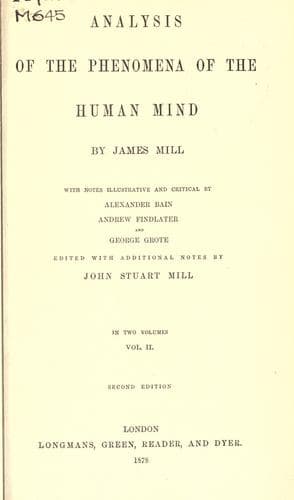
Analysis of the Phenomena of the Human MindMill, James
PhilosophyPhilosophy
Analysis of the Phenomena of the Human Mind
Mill, James
Psychology
It seems to follow from the universal law of association, that any
idea could be associated with any other idea, if the corresponding
sensations, or even the ideas themselves, were presented in
juxtaposition with sufficient frequency. If, therefore, there are
ideas which cannot be associated with each other, it must be because
there is something that prevents this juxtaposition. Two conditions
hence appear to be required, to render ideas incapable of
combination. First, the sensations must be incapable of being had
together. If we cannot associate the taste of assafoetida with the
taste of sugar, it is implied, that we cannot have the taste of
assafoetida along with the taste of sugar. If we could, a
sufficient experience would enable us to associate the ideas. Here,
therefore, is one necessary condition of the impossibility of
associating certain ideas with one another. But this condition,
though necessary, is not sufficient. We are but too capable of
associating ideas together though the corresponding external facts
are really incompatible. In the case of many errors, prejudices, and
superstitions, two ideas are so closely and obstinately associated,
that the man cannot, at least for the time, help believing that the
association represents a real coexistence or sequence between
outward facts, though such coexistence or sequence may contradict a
positive law of the physical world. There is therefore a further
condition required to render two ideas unassociable, and this is,
that one of them shall be already associated with some idea which
excludes the other. Thus far the analysis is carried in the author's
text. But the question remains, what ideas exclude one another? On
careful consideration I can only find one case of such exclusion:
when one of the ideas either contains, or raises up by association,
the idea of the absence of the other. I am aware of no case of
absolute incompatibility of thought or of imagination, except
between the presence of something and its absence; between an
affirmative and the corresponding negative. If an idea irresistibly
raises up the idea of the absence of a certain sensation, it cannot
become associated with the idea of that sensation; for it is
impossible to combine together in the same mental representation,
the presence of a sensation and its absence.
Public-domain text, read in full here on John Shaqi.
Reviews
Reviews
No reviews yet
Be the first to share your thoughts on this work.
Elsewhere in the archive
Join the Discussion
Join the discussion
Sign in to leave a comment or review.
Sign InorCreate an account