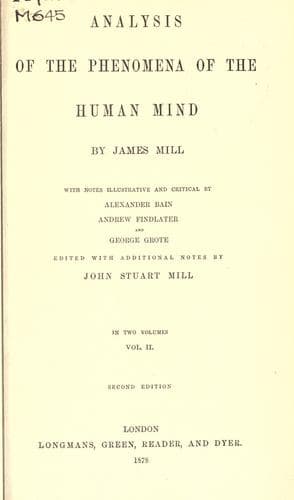
Analysis of the Phenomena of the Human MindMill, James
PhilosophyPhilosophy
Analysis of the Phenomena of the Human Mind
Mill, James
Psychology
We are not yet, however, at the end of the difficulty; for it may be
objected, that the idea of the absence of anything is the idea of a
negation, of a nullity; and the idea of nothing must itself be
nothing--no idea at all. This objection has imposed upon more than
one metaphysician; but the solution of the paradox is very simple.
The idea of the presence of a sensation is the idea of the sensation
itself along with certain accompanying circumstances: the idea of
the absence of the sensation is the idea of the same accompanying
circumstances without the sensation. For example: my idea of a body
is the idea of a feeling of resistance, accompanying a certain
muscular action of my own, say of my hand; my idea of no body, in
other words, of empty space, is the idea of the same or a similar
muscular action of my own, not attended by any feeling of
resistance. Neither of these is an idea of a mere negation; both are
positive mental representations: but inasmuch as one of them
includes the negation of something positive which is an actual part
of the other, they are mutually incompatible: and any idea which is
so associated with one of them as to recall it instantly and
irresistibly, is incapable of being associated with the other.
The instance cited by the author from Dr. Brown, is a good
illustration of the law. We can associate the ideas of a plane and
of a convex surface as two surfaces side by side; but we cannot fuse
the two mental images into one, and represent to ourselves the very
same series of points giving us the sensations we receive from a
plane surface and those we receive from a convex surface both at
once. That this cannot but be so, is a corollary from the elementary
law of association. Not only has no instance ever occurred in our
experience of a surface which gave us at the same moment both these
sets of sensations; but whenever in our experience a surface
originally plane, came to give us the sensations we receive from a
convex surface (as for instance when we bend a flat sheet of paper),
it, at the very same moment, ceased to be, or to appear, a plane.
The commencement of the one set of sensations has always been
simultaneous with the cessation of the other set, and this
experience, not being affected by any change of circumstances, has
the constancy and invariability of a law of nature. It forms a
correspondingly strong association; and we become unable to have an
idea of either set of sensations, those of planeness or those of
convexity, without having the idea of the disappearance of the other
set, if they existed previously. I believe it will be found that all
the mental incompatibilities, the impossibilities of thought, of
which so much is made by a certain class of metaphysicians, can be
accounted for in a similar manner.--_Ed._]
Public-domain text, read in full here on John Shaqi.
Reviews
Reviews
No reviews yet
Be the first to share your thoughts on this work.
Elsewhere in the archive
Join the Discussion
Join the discussion
Sign in to leave a comment or review.
Sign InorCreate an account