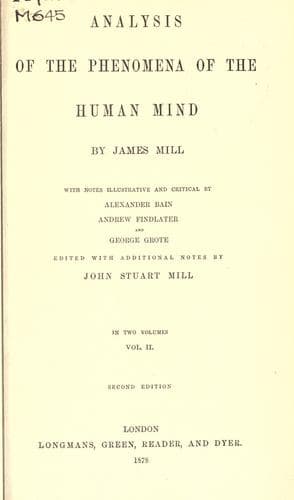
Analysis of the Phenomena of the Human MindMill, James
PhilosophyPhilosophy
Analysis of the Phenomena of the Human Mind
Mill, James
Psychology
The first, however, of the examples by which the author illustrates
this law, is not marked by his usual felicity. Its shortcomings are
pointed out by Mr. Bain in the preceding note. The internal feelings
(says the author) which accompany indigestion, introduce trains of
ideas (as in the case of horrible dreams, and of hypochondria) which
are acutely painful, and may embitter the whole existence, while the
sensations themselves, being comparatively of little interest, are
unheeded and forgotten. It is true that the sensations in the
alimentary canal, directly produced by indigestion, though (as every
one knows) in some cases intense, are in others so slight as not to
fix the attention, and yet may be followed by melancholy trains of
thought, the connection of which with the state of the digestion may
be entirely unobserved: but by far the most probable supposition
appears to be, that these painful trains are not excited by the
sensations, but that they and the sensations are joint or successive
effects of a common organic cause. It is difficult to comprehend how
these obscure sensations can excite the distressing trains of ideas
by the laws of association; for what opportunity have these
sensations usually had of becoming associated, either synchronously
or successively, with those ideas? The explanation, in the text, of
this difficulty, seems surprisingly insufficient. Anxiety, in most
people, disorders the digestion; and consequently, according to the
author, the sensations of indigestion excite the ideas which prevail
in a state of anxiety. If that were the true explanation, the only
persons with whom indigestion would depress the spirits, would be
those who had suffered previous depression of spirits, sufficient in
duration and intensity to disorder the digestion, and to keep it
disordered long enough to effect a close and inseparable cohesion
between even very slight sensations of indigestion and painful ideas
excited by other causes. Surely this is not the fact. The theory has
a true application in the case of the confirmed hypochondriac. When
the sensations have been repeatedly experienced along with the
melancholy trains of thought, a direct association is likely to grow
up between the two; and when this has been effected, the first touch
of the sensations may bring back in full measure the miserable
mental state which had coexisted with them, thus increasing not only
the frequency of its recurrence, but, by the conjunction of two
exciting causes, the intensity of the misery. But the origin of the
state must be looked for elsewhere, and is probably to be sought in
physiology.
Public-domain text, read in full here on John Shaqi.
Reviews
Reviews
No reviews yet
Be the first to share your thoughts on this work.
Elsewhere in the archive
Join the Discussion
Join the discussion
Sign in to leave a comment or review.
Sign InorCreate an account