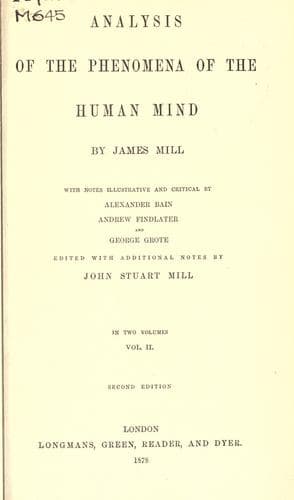
Analysis of the Phenomena of the Human MindMill, James
PhilosophyPhilosophy
Analysis of the Phenomena of the Human Mind
Mill, James
Psychology
[Bain's footnote 33: Perhaps the most remarkable case of sensations
overlooked on their own account, and considered only as a means of
suggesting something else, is the visual, or retinal, magnitude of
objects seen by the eye. This is probably the most delicate
sensibility within the compass of the mind; and yet we habitually
disregard it for all things near us, and use it solely for
perceiving real magnitude as estimated by our locomotive and other
members. The visual magnitude of a table, or other article in a
room, is never thought of for itself; although incessantly
fluctuating we never think of the fluctuations; we pass from these
to the one constant perception, named the true or real magnitude. It
is only for remote objects, as the sun and moon, the clouds, the
distant hills, that the retinal magnitude abides with us in its own
proper character. In looking down a vista, we may also be aroused to
the feeling of retinal magnitude. For perspective drawing, it is
necessary that we should arrest the strong tendency to pass from the
visible, to the real, forms and dimensions of things.--_B._]
[Editor's footnote 34: The reader, it may be hoped, is now familiar
with the important psychological fact, so powerfully grasped and so
discerningly employed by Hartley and the author of the
Analysis,--that when, through the frequent repetition of a series of
sensations, the corresponding train of ideas rushes through the mind
with extreme rapidity, some of the links are apt to disappear from
consciousness as completely as if they had never formed part of the
series. It has been a subject of dispute among philosophers which of
three things takes place in this case. Do the lost ideas pass
through the mind without consciousness? Do they pass consciously
through the mind and are they then instantly forgotten? Or do they
never come into the mind at all, being, as it were, overleaped and
pressed out by the rush of the subsequent ideas?
It would seem, at first sight, that the first and third suppositions
involve impossibilities, and that the second, therefore, is the only
one which we are at liberty to adopt. As regards the first, it may
be said--How can we have a feeling without feeling it, in other
words, without being conscious of it? With regard to the third, how,
it may be asked, can any link of the chain have been altogether
absent, through the pressure of the subsequent links? The subsequent
ideas are only there because called up by it, and would not have
arisen at all unless it had arisen first, however short a time it
may have lasted. These arguments seem strong, but are not so strong
as they seem.
Public-domain text, read in full here on John Shaqi.
Reviews
Reviews
No reviews yet
Be the first to share your thoughts on this work.
Elsewhere in the archive
Join the Discussion
Join the discussion
Sign in to leave a comment or review.
Sign InorCreate an account