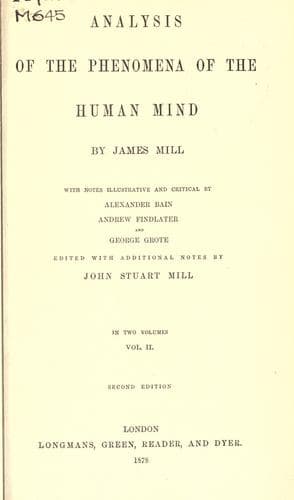
Analysis of the Phenomena of the Human MindMill, James
PhilosophyPhilosophy
Analysis of the Phenomena of the Human Mind
Mill, James
Psychology
In favour of the first supposition, that feelings may be
unconsciously present, various facts and arguments are adduced by
Sir William Hamilton in his Lectures; but I think I have shewn in
another work, that the arguments are inconclusive, and the facts
equally reconcilable with the second of the three hypotheses. That a
feeling should not be felt appears to me a contradiction both in
words and in nature. But, though a feeling cannot exist without
being felt, the organic state which is the antecedent of it may
exist, and the feeling itself not follow. This happens, either if
the organic state is not of sufficient duration, or if an organic
state stronger than itself, and conflicting with it, is affecting us
at the same moment. I hope to be excused for quoting what I have
said elsewhere on this subject (Examination of Sir William
Hamilton's Philosophy, ch. 15).
"In the case, for instance, of a soldier who receives a wound in
battle, but in the excitement of the moment is not aware of the
fact, it is difficult not to believe that if the wound had been
accompanied by the usual sensation, so vivid a feeling would have
forced itself to be attended to and remembered. The supposition
which seems most probable is, that the nerves of the particular part
were affected as they would have been by the same cause in any other
circumstances, but that, the nervous centres being intensely
occupied with other impressions, the affection of the local nerves
did not reach them, and no sensation was excited. In like manner, if
we admit (what physiology is rendering more and more probable) that
our mental feelings, as well as our sensations, have for their
physical antecedents particular states of the nerves; it may well be
believed that the apparently suppressed links in a chain of
association, those which Sir William Hamilton considers as latent,
really are so; that they are not, even momentarily, felt; the chain
of causation being continued only physically, by one organic state
of the nerves succeeding another so rapidly that the state of mental
consciousness appropriate to each is not produced. We have only to
suppose, either that a nervous modification of too short duration
does not produce any sensation or mental feeling at all, or that the
rapid succession of different nervous modifications makes the
feelings produced by them interfere with each other, and become
confounded in one mass. The former of these suppositions is
extremely probable, while of the truth of the latter we have
positive proof. An example of it is the experiment which Sir W.
Hamilton quoted from Mr. Mill, and which had been noticed before
either of them by Hartley. It is known that the seven prismatic
colours, combined in certain proportions, produce the white light of
the solar ray. Now, if the seven colours are painted on spaces
bearing the same proportion to one another as in the solar spectrum,
and the coloured surface so produced is passed rapidly before the
Public-domain text, read in full here on John Shaqi.
Reviews
Reviews
No reviews yet
Be the first to share your thoughts on this work.
Elsewhere in the archive
Join the Discussion
Join the discussion
Sign in to leave a comment or review.
Sign InorCreate an account