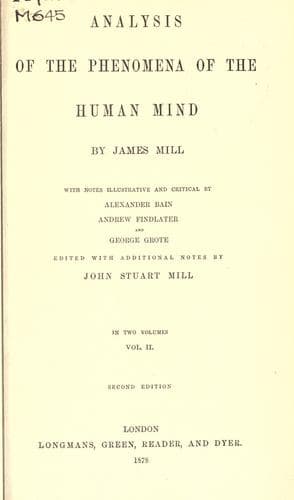
Analysis of the Phenomena of the Human MindMill, James
PhilosophyPhilosophy
Analysis of the Phenomena of the Human Mind
Mill, James
Psychology
{106} 11. Mr. Hume, and after him other philosophers, have said that
our ideas are associated according to {107} three principles;
Contiguity in time and place, Causation, and Resemblance. The
Contiguity in time and {108} place, must mean, that of the
sensations; and so far it is affirmed, that the order of the ideas
follows that {109} of the sensations. Contiguity of two sensations
in time, means the successive order. Contiguity of two {110}
sensations in place, means the synchronous order. We have explained
the mode in which ideas are associated, in the synchronous, as well
as the successive order, and have traced the principle of contiguity
to its proper source.
Causation, the second of Mr. Hume's principles, is the same with
contiguity in time, or the order of succession. Causation is only a
name for the order established between an antecedent and a
consequent; that is, the established or constant antecedence of the
one, {111} and consequence of the other. Resemblance only remains,
as an alleged principle of association, and it is necessary to
inquire whether it is included in the laws which have been above
expounded. I believe it will be found that we are accustomed to see
like things together. When we see a tree, we generally see more
trees than one; when we see an ox, we generally see more oxen than
one; a sheep, more sheep than one; a man, more men than one. From
this observation, I think, we may refer resemblance to the law of
frequency, of which it seems to form only a particular case.[35]
[Editor's footnote 35: The reason assigned by the author for
considering association by resemblance as a case of association by
contiguity, is perhaps the least successful attempt at a
generalisation and simplification of the laws of mental phenomena,
to be found in the work. It ought to be remembered that the author,
as the text shows, attached little importance to it. And perhaps,
not thinking it important, he passed it over with a less amount of
patient thought than he usually bestowed on his analyses.
Public-domain text, read in full here on John Shaqi.
Reviews
Reviews
No reviews yet
Be the first to share your thoughts on this work.
Elsewhere in the archive
Join the Discussion
Join the discussion
Sign in to leave a comment or review.
Sign InorCreate an account