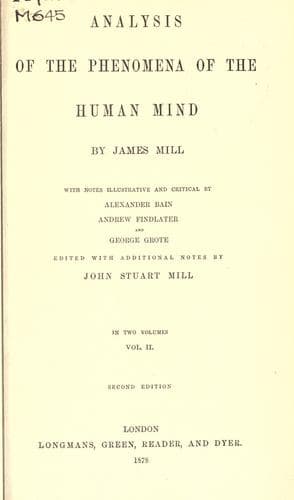
Analysis of the Phenomena of the Human MindMill, James
PhilosophyPhilosophy
Analysis of the Phenomena of the Human Mind
Mill, James
Psychology
In this modified form, therefore, the first of the three hypotheses
may possibly be true. Let us now consider the third, that of the
entire elision of some of the ideas which form the associated train.
This supposition seemed to be inadmissible, because the loss of any
link would, it was supposed, cause the chain itself to break off at
that point. To make the hypothesis possible, it is only, however,
necessary to suppose, that, while the association is acquiring the
promptitude and rapidity which it ultimately attains, each of the
successive ideas abides for a brief interval in our consciousness
after it has already called up the idea which is to succeed it. Each
idea in the series, though introduced, not by synchronous, but by
successive association, is thus, during a part of its continuance,
synchronous with the idea which introduced it: and as the rapidity
of the suggestions increases by still further repetition, an idea
may become synchronous with another which was originally not even
contiguous to it, but separated from it by an intervening link; or
may come into immediate instead of mediate sequence with such an
idea. When either of these states of things has continued for some
time, a direct association of the synchronous or of the successive
kind will be generated between two ideas which are not proximate
links in the chain; A will acquire a direct power of exciting C,
independently of the intervening idea B. If, then, B is much less
interesting than C, and especially if B is of no importance at all
in itself, but only by exciting C, and has therefore nothing to make
the mind dwell on it after C has been reached, the association of A
with C is likely to become stronger than that of A with B: C will be
habitually excited directly by A; as the mind runs off to the
further ideas suggested by C, B will cease to be excited at all; and
the train of association, like a stream which breaking though its
bank cuts off a bend in its course, will thenceforth flow in the
direct line AC, omitting B. This supposition accounts more plausibly
than either of the others for the truly wonderful rapidity of
thought, since it does not make so large a demand as the other
theories on our ability to believe that a prodigious number of
different ideas can successively rush through the mind in an instant
too short for measurement.
The result is, that all the three theories of this mental process
seem to be quite possible; and it is not unlikely that each of them
may be the real process in some cases, either in different persons,
or in the same persons under different circumstances. I can only
remit the question to future psychologists, who may be able to
contrive crucial experiments for deciding among these various
possibilities.--_Ed._]
Public-domain text, read in full here on John Shaqi.
Reviews
Reviews
No reviews yet
Be the first to share your thoughts on this work.
Elsewhere in the archive
Join the Discussion
Join the discussion
Sign in to leave a comment or review.
Sign InorCreate an account