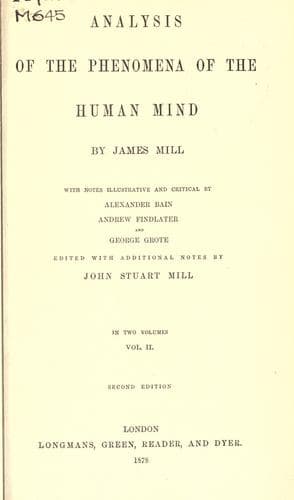
Analysis of the Phenomena of the Human MindMill, James
PhilosophyPhilosophy
Analysis of the Phenomena of the Human Mind
Mill, James
Psychology
When it is admitted that simple sensations remind us of one another
by direct resemblance, many of the complex cases of suggestion by
resemblance may be analysed into this elementary case of association
by resemblance, combined with an association by contiguity. A
flower, for instance, may remind us of a former flower resembling
it, because the present flower exhibits to us certain qualities,
that is, excites in us certain sensations, resembling and recalling
to our remembrance those we had from the former flower, and these
recall the entire image of the flower by the law of association by
contiguity. But this explanation, though it serves for many cases of
complex phenomena suggesting one another by resemblance, does not
suffice for all. For, the resemblance of complex facts often
consists, not solely, or principally, in likeness between the simple
sensations, but far more in likeness of the manner of their
combination, and it is often by this, rather than by the single
features, that they recall one another. After we had seen, and well
observed, a single triangle, when we afterwards saw a second there
can be little doubt that it would at once remind us of the first by
mere resemblance. But the suggestion would not depend on the sides
or on the angles, any or all of them; for we might have seen such
sides and such angles uncombined, or combined into some other
figure. The resemblance by which one triangle recalls the idea of
another is not resemblance in the parts, but principally and
emphatically in the manner in which the parts are put together. I am
unable to see any mode in which this case of suggestion can be
accounted for by contiguity; any mode, at least, which would fit all
cases of the kind.--_Ed._]
{112} Mr. Hume makes contrast a principle of association, but not a
separate one, as he thinks it is compounded {113} of Resemblance and
Causation. It is not necessary for us to show that this is an
unsatisfactory account {114} of contrast. It is only necessary to
observe, that, as a case of association, it is not distinct from
those which we have above explained.
A dwarf suggests the idea of a giant. How? We call a dwarf a dwarf,
because he departs from a certain standard. We call a giant a giant,
because he departs from the same standard. This is a case,
therefore, of resemblance, that is, of frequency.
Pain is said to make us think of pleasure; and this is considered a
case of association by contrast. There is no doubt that pain makes
us think of relief from it; because they have been conjoined, and
the great vividness of the sensations makes the association strong.
Relief from pain is a species of pleasure; and one pleasure leads to
think of another, from the resemblance. This is a compound case,
therefore, of vividness and frequency. All other cases of contrast,
I believe, may be expounded in a similar manner.
Public-domain text, read in full here on John Shaqi.
Reviews
Reviews
No reviews yet
Be the first to share your thoughts on this work.
Elsewhere in the archive
Join the Discussion
Join the discussion
Sign in to leave a comment or review.
Sign InorCreate an account