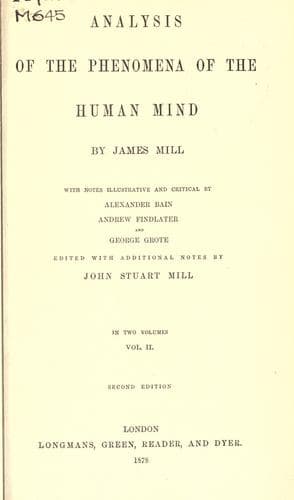
Analysis of the Phenomena of the Human MindMill, James
PhilosophyPhilosophy
Analysis of the Phenomena of the Human Mind
Mill, James
Psychology
I have not thought it necessary to be tedious in expounding the
observations which I have thus stated; for whether the reader
supposes that resemblance is, or is not, an original principle of
association, will not affect our future investigations.
12. Not only do simple ideas, by strong association, run together,
and form complex ideas: but a {115} complex idea, when the simple
ideas which compose it have become so consolidated that it always
appears as one, is capable of entering into combinations with other
ideas, both simple and complex. Thus two complex ideas may be united
together, by a strong association, and coalesce into one, in the
same manner as two or more simple ideas coalesce into one. This
union of two complex ideas into one, Dr. Hartley has called a duplex
idea.[37] Two also of these duplex, or doubly compounded ideas, may
unite into one; and these again into other compounds, without end.
It is hardly necessary to mention, that as two complex ideas unite
to form a duplex one, not only two, but more than two may so unite;
and what he calls a duplex idea may be compounded of two, three,
four, or any number of complex ideas.
[Editor's footnote 37: I have been unable to trace in Hartley the
expression here ascribed to him. In every passage that I can
discover, the name he gives to a combination of two or more complex
ideas is that of a _decomplex_ idea.--_Ed._]
Some of the most familiar objects with which we are acquainted
furnish instances of these unions of complex and duplex ideas.
Brick is one complex idea, mortar is another complex idea; these
ideas, with ideas of position and quantity, compose my idea of a
wall. My idea of a plank is a complex idea, my idea of a rafter is a
complex idea, my idea of a nail is a complex idea. These, united
with the same ideas of position and quantity, compose my duplex idea
of a floor. In the same manner my complex idea of glass, and wood,
and others, compose my duplex idea of a window; and {116} these
duplex ideas, united together, compose my idea of a house, which is
made up of various duplex ideas. How many complex, or duplex ideas,
are all united in the idea of furniture? How many more in the idea
of merchandize? How many more in the idea called Every Thing?[38]
[39]
[Bain's footnote 38: This chapter raises questions of the most
fundamental kind relating to our intellectual constitution. The
Association of Ideas, comprehensively viewed, involves everything
connected with the mental persistence and reproduction of ideas;
being offered as adequate to explain the operations named Memory,
Reason, and Imagination.
Public-domain text, read in full here on John Shaqi.
Reviews
Reviews
No reviews yet
Be the first to share your thoughts on this work.
Elsewhere in the archive
Join the Discussion
Join the discussion
Sign in to leave a comment or review.
Sign InorCreate an account