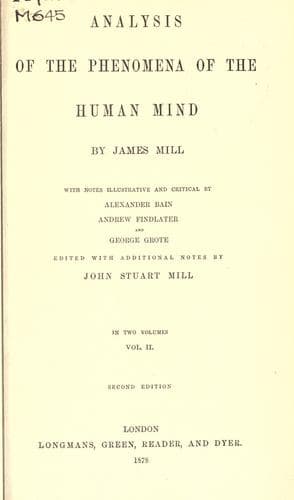
Analysis of the Phenomena of the Human MindMill, James
PhilosophyPhilosophy
Analysis of the Phenomena of the Human Mind
Mill, James
Psychology
pupil may be to abide by the task prescribed.
The influence of the Feelings upon Retentiveness is not throughout
in proportion to their degree, whether they are pleasurable,
painful, or neutral. We have to introduce a modifying circumstance
into the case, namely, that great strength of feeling absorbs the
forces of the system, and diminishes the power available for
cementing an intellectual association. A strong feeling once
aroused, while inflaming the attention upon whatever is bound up
with it, necessarily engages us with itself. The plastic process of
fixing a train or aggregate of ideas has but a share of the energies
awakened under feeling.
It is possible also to stimulate attention, and thereby to {118}
quicken memory, without the excitement of the feelings, as in pure
voluntary attention. For although the will, in the last resort, is
stimulated by an end (which must involve the feelings), yet we may
be strongly moved without being under the excitement of the feelings
that enter into the final end. Our volitions may be energetic,
without the presence of strong emotions, notwithstanding that, apart
from our possessing such emotions, we should not be strongly moved
to action. Thus, a difference is made between the influence of the
feelings and the influence of the will; both being powers to impress
the memory.
The two considerations now advanced, namely, the want of strict
concomitance between strength of feeling and the stimulus to memory,
and the operation of the will in the abeyance of present feeling,
make it desirable to find some other mode of stating the element or
condition that qualifies the influence of Frequency or Repetition,
in the growth of memory and association. Perhaps the best mode of
singling out the operative circumstance is to describe it as
"Concentration of Mind;" the devotion of the mental forces to the
thing to be done or remembered--the withdrawal of power from other
exercises, to expend it on the exercise in hand. Every circumstance
that at once rouses the mental and nervous energies, and keeps them
fixed upon any subject of study or the practice of any art, is a
circumstance in aid of acquisition. No fact more comprehensive, more
exactly in point, can be assigned than the one now stated. What
remains is to apply it in the detail, or to point out the occasions
and conditions that favour, and those that obstruct, the
concentration of the mental energy. It is under this view that we
can best appreciate the efficacy of pleasure (interest in the
subject), of pain, of mere excitement, and of voluntary attention.
We can also see, as an obvious corollary, the advantage of having
the mind unoccupied, or disengaged for the work, and the
disadvantage of being diverted, or distracted by other objects.
Fear, care, anxiety, are hostile to culture by lowering the tone or
energy of the mind; while what power is left concentrates itself
upon the subject matter of the anxious feeling. On the other hand,
Public-domain text, read in full here on John Shaqi.
Reviews
Reviews
No reviews yet
Be the first to share your thoughts on this work.
Elsewhere in the archive
Join the Discussion
Join the discussion
Sign in to leave a comment or review.
Sign InorCreate an account