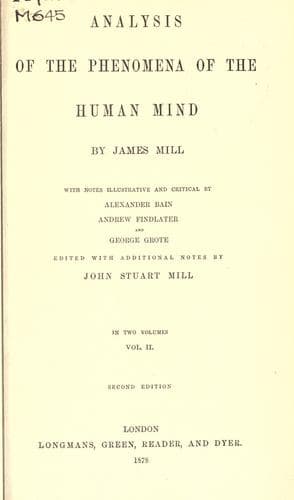
Analysis of the Phenomena of the Human MindMill, James
PhilosophyPhilosophy
Analysis of the Phenomena of the Human Mind
Mill, James
Psychology
_Conditions of the Growth of Association, or of the Retentiveness of
the Mind_.--A practical, as well as a theoretical, interest attaches
to the precise statement of the conditions or circumstances that
regulate the growth of our associations, in other words our mental
culture generally. All agree in the efficacy of the two conditions
mentioned in the text; the vividness of the feelings associated, and
the frequency of the association, that is repetition or practice. It
is well remarked, however, that the phrase "vividness of the
sensations or ideas" does not convey a very precise meaning. The
proper attribute of a sensation, or an idea, considered as an
_intellectual_ element, is greater or less distinctness; when an
object seen or remembered is seen or remembered distinctly and
fully, and without any unusual labour or effort, there is nothing
more to be desired, so far as concerns our intelligence. If,
however, the object is accompanied with _feeling_--with pleasure or
pain--a new element is introduced, to which other epithets are
applicable. A feeling is more or less strong or intense; and the
addition of an intense feeling to an intellectual conception is a
sum, combining both sets of attributes--distinctness and adequacy in
the conception, and intensity in the feeling. An object whose
perception or conception is thus accompanied with the animation of
strong feeling, is called lively, or vivid; {117} in the absence of
feeling, these epithets are unsuitable. Hence, the associating
stimulus expressed by "vividness" is better expressed by the
"strength of the feelings." Any strong feeling impresses on the mind
whatever is the object of it, or is in any way mixed up with it. We
remember by preference the things that have given us either pleasure
or pain; and the effect may be produced by mere excitement although
neither pleasurable nor painful; the influence of a surprise being a
case in point. Our _interest_ in a thing is but another name for the
pleasure that it gives us; and to inspire interest is to aid the
memory. Hamilton's Law of Preference refers to this source; and
appears to exclude, or not to recognise, the efficacy of feelings
not pleasurable, namely, such as are either painful or neutral. The
comprehensive law should include all the feelings, although there
are specific characters attaching to the influence of each of the
three modes. Pleasure is the most effectual in stamping the memory,
as it is the most powerful in detaining the attention and the
thoughts. Pain has a conflicting operation; as affecting the will,
it repels the object; but as mere excitement it retains it; we
cannot forget what is disagreeable, merely because we wish to forget
it. The stimulant of pain, as applied in education, is an indirect
pleasure. It is not intended to make the subject of the lesson
disagreeable, but to render painful all diversions from that towards
other subjects; so that comparatively the most pleasing course to a
Public-domain text, read in full here on John Shaqi.
Reviews
Reviews
No reviews yet
Be the first to share your thoughts on this work.
Elsewhere in the archive
Join the Discussion
Join the discussion
Sign in to leave a comment or review.
Sign InorCreate an account