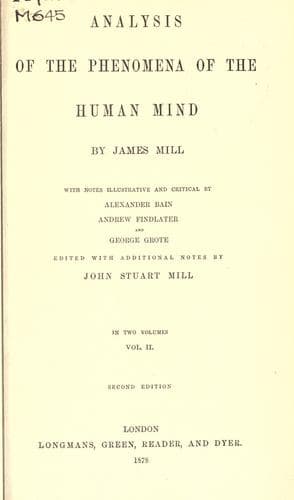
Analysis of the Phenomena of the Human MindMill, James
PhilosophyPhilosophy
Analysis of the Phenomena of the Human Mind
Mill, James
Psychology
{120} The second case, the inequality of the same person's progress
in different subjects, may be looked at in another way. We may view
it as incident to the better or worse quality, for all purposes, of
the special organs concerned. Thus to take musical acquisition. This
is commonly attributed to a good ear, meaning a delicate sense of
musical notes, as shown in their nice discrimination. Discriminating
is a different function from remembering; yet, we can only doubt
that the fact of being able to discriminate acutely is accompanied
by the power of remembering or retaining the impressions of the
sense. The superiority of endowment that shows itself in the one
function, embraces also the other. Hence we are entitled to say that
the special retentiveness for any one subject, or department of
training, varies with the local endowment involved: which is not to
maintain an identical proposition, for the local endowment may be
held as tested by delicacy of discrimination, a distinct fact from
memory. Thus, a delicate sense of shades of colour would entail a
good visual memory for spectacle; a delicate ear for articulation
would indicate a memory for shades and varieties of pronunciation,
thereby counting as a part of the verbal memory. So, delicate
discrimination in the tactile muscles would be followed by rapid
acquirements in manipulative or manual art.
_The Ultimate Analysis of the Laws of Association_.--It is easy to
reduce all the laws ever assigned, as governing the reproduction of
our ideas, to three, Contiguity, Similarity, and Contrast. It is
open to question whether these can be resolved any farther. The
author has endeavoured to reduce Similarity to Contiguity, but his
reasons show that he had not deeply considered the workings of
similarity. Hamilton's criticisms on the attempt (Reid, p. 914) are
just and irrefragable. By far the most important examples of the
working of similarity are such as, by their very nature, preclude a
former contiguity: as, for example, Franklin's identification of
Electricity and lightning.
Public-domain text, read in full here on John Shaqi.
Reviews
Reviews
No reviews yet
Be the first to share your thoughts on this work.
Elsewhere in the archive
Join the Discussion
Join the discussion
Sign in to leave a comment or review.
Sign InorCreate an account