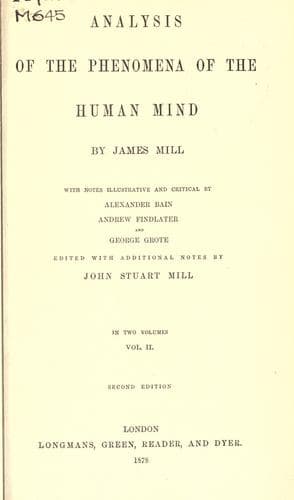
Analysis of the Phenomena of the Human MindMill, James
PhilosophyPhilosophy
Analysis of the Phenomena of the Human Mind
Mill, James
Psychology
There is, nevertheless, a considerable degree of subtlety in the
relationship of the two principles. There may be good reasons {121}
for treating them as distinct, but in their working they are
inextricably combined. There can be no contiguity without
similarity, and no similarity without contiguity. When, looking at a
river, we pronounce its name, we are properly said to exemplify
contiguity; the river and the name by frequent association are so
united that each recalls the other. But mark the steps of the
recall. What is strictly present to our view is the impression made
by the river while we gaze on it. It is necessary that this
impression should, by virtue of similarity or identity, re-instate
the previous impression of the river, to which the previous
impression of the name was contiguous. If one could suppose failure
in the re-instatement of the former idea of the river, under the new
presentation, there would be no opportunity given to the contiguous
bond to come into operation. In that accumulation of the impressions
of contiguous ideas, ending at last in a firm association, there
must be a process of similarity to the extent of reviving the sum of
the past at the instance of the present. This is a case of
similarity that we give little heed to, because it is sure and
unfailing; we concern ourselves more with what is liable to
uncertainty, the acquired strength of the contiguous adhesion. Yet
it strictly comes under the case of reproduction through similarity.
Consider again, what may be called a case of Similarity proper, as
when a portrait recalls the original. The sensuous effects possessed
in common by the portrait and by its subject bring about a
restoration of the idea of the subject, in spite of certain
differences or discrepancies. The interest of this case is owing to
the fact that a partial likeness, a likeness in unlikeness, will
often reproduce a past idea; thus enabling us to assemble in the
mind a number of things differing in some respects because they
agree in other respects. This is not identifying a thing with
itself, viewed at a former time, but assimilating one thing with
other things placed far asunder in nature, and having many features
of difference.
Public-domain text, read in full here on John Shaqi.
Reviews
Reviews
No reviews yet
Be the first to share your thoughts on this work.
Elsewhere in the archive
Join the Discussion
Join the discussion
Sign in to leave a comment or review.
Sign InorCreate an account