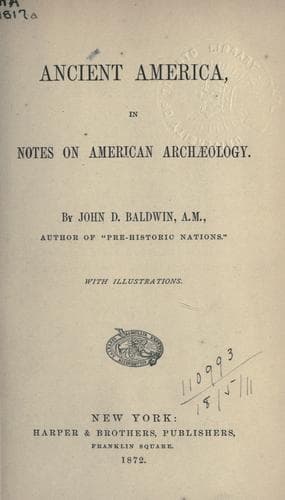
Ancient America, in Notes on American ArchaeologyBaldwin, John D. (John Denison)
History
Ancient America, in Notes on American Archaeology
Baldwin, John D. (John Denison)
America -- Antiquities; America -- Discovery and exploration -- Pre-Columbian; Indians -- Antiquities
Finally, in March, 1519, Cortez landed near the place where Vera Cruz
was afterward built, and moved on through the country toward the city of
Mexico. Studying, in all the histories of the Conquest, only their
incidental references to the civilized condition of the people, we can
see plainly what it was. As the invaders approached Tlascala, they found
“beautiful whitewashed houses” scattered over the country. The
Tlascalans had towns, cities, agriculture, and markets. Cortez found
among them all that was needed by his troops. His supremacy in Tlascala
was easily established; and it was not difficult to induce the people to
aid him cordially in his operations against Mexico, for they hated the
Aztecs, by whom they had recently been subjugated. In a description of
their capital, he stated that it was as large as the city of Granada, in
Spain.
He went next to Cholulu, where, near the great mound, was an important
city, in which they saw a “great plaza.” Bernal Diaz said of this city,
“I well remember, when we first entered this town and looked up to the
elevated white temples, how the whole place put us completely in mind of
Valladolid.” The “white temples” were “elevated” because they stood on
high pyramidal foundations, just as they are seen in the old ruins. It
is probable, however, that these were built of adobe bricks or of
timber. The city very likely was much older than the Aztec empire. A
Spanish officer named Ordaz ascended Mount Popocatapetl, and one thing
he saw was “the Valley of Mexico, with its city, its lagunas and
islands, and its scattered hamlets, a busy throng of life being every
where visible.”
THE CITY OF MEXICO.
At the city of Mexico Cortez had a great reception, negotiation having
established the form of friendly relations between him and Montezuma.
Quarters were provided in the city for the Spanish portion of his army,
a vast edifice being set apart for their use which furnished ample
accommodations for the whole force. The place could be entered only by
causeways. They marched on a wide avenue which led through the heart of
the city, beholding the size, architecture, and beauty of the Aztec
capital with astonishment. This avenue was lined with some of the finest
houses, built of a porous red stone dug from quarries in the
neighborhood. The people gathered in crowds on the streets, on the flat
roofs, in the doorways, and at the windows to witness the arrival of the
Spaniards. Most of the streets were narrow, and had houses of a much
less imposing character. The great streets went over numerous canals, on
well-built bridges. Montezuma’s palace was a low, irregular pile of
stone structures extending over a large space of ground.
Public-domain text, read in full here on John Shaqi.
Reviews
Reviews
No reviews yet
Be the first to share your thoughts on this work.
Elsewhere in the archive
Join the Discussion
Join the discussion
Sign in to leave a comment or review.
Sign InorCreate an account