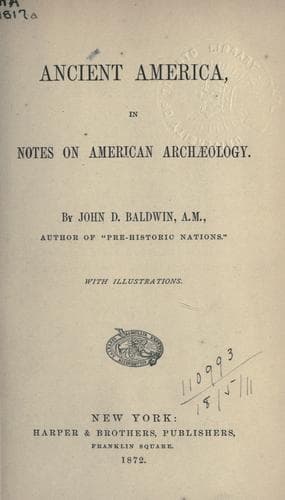
Ancient America, in Notes on American ArchaeologyBaldwin, John D. (John Denison)
History
Ancient America, in Notes on American Archaeology
Baldwin, John D. (John Denison)
America -- Antiquities; America -- Discovery and exploration -- Pre-Columbian; Indians -- Antiquities
Among the _teocallis_ of the Aztec capital the “great temple” stood
foremost. It was situated in the centre of a vast inclosure, which was
surrounded by a heavy wall eight feet high, built of prepared stone.
This inclosure was entered by four gateways opening on the four
principal streets of the city. The “temple” was a solid structure built
of earth and pebbles, and faced from top to bottom with hewn stone laid
in mortar. It had five stages, each receding so as to be smaller than
that below it. In general outline it was a rectangular pyramid three
hundred feet square at the base, with a level summit of considerable
extent, on which were two towers, and two altars where “perpetual fires”
were maintained. Here the religious ceremonies were conducted. The
ascent was by a circular flight of steps on the outside which went four
times around the structure. The water in the lagoons being salt, the
city was supplied with water by means of an aqueduct which extended to
Chapultepec.
Such substantially is the account given of the old city of Mexico and
its great temple by every writer who saw them before the Conquest, and
all the struggles which took place for possession of this capital had a
character that would have been impossible any where save in a large
city. In every account of the attacks on the great temple, we can see
that it was a great temple; and we may perceive what the old city was by
reading any account of the desperate and bloody battles in which the
Spaniards were driven from it, after standing a ten days’ siege in the
great stone building they occupied.
THE CONQUEST.
This battle took place in the latter part of June, 1520, several months
after the friendly reception, and was occasioned by the treacherous and
most atrocious proceedings of the Spaniards, which drove the Mexicans to
madness. Nearly a year passed before Cortez made another attack on the
Mexican capital. During this time he found means among the Tlascalans to
build a flotilla of thirteen vessels, which were transported in pieces
to Lake Tezcuco and there put together. This would have been impossible
if he had not found in the country suitable tools and mechanics. By
means of these vessels armed with cannon, and assisted by a great army
of native allies consisting of Tlascalans, Cholulans, and many others,
he took control of the lagunas, secured possession of the causeways, and
attacked the city in vain for forty-five days, although his men several
times penetrated to the great square. He now resolved to enter by
gradual advances, and destroy every thing as he went. This he did,
burning what was combustible, and tearing down most of the edifices
built of stone; nevertheless, thirty or forty days more passed before
this work of destruction was complete. The inhabitants of the city were
given over to extermination.
Public-domain text, read in full here on John Shaqi.
Reviews
Reviews
No reviews yet
Be the first to share your thoughts on this work.
Elsewhere in the archive
Join the Discussion
Join the discussion
Sign in to leave a comment or review.
Sign InorCreate an account