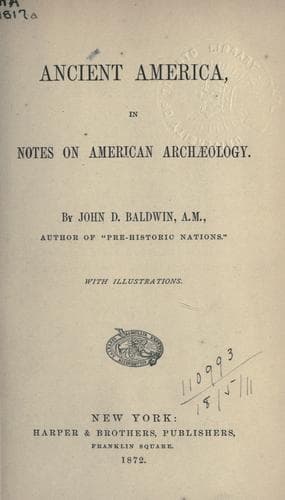
Ancient America, in Notes on American ArchaeologyBaldwin, John D. (John Denison)
History
Ancient America, in Notes on American Archaeology
Baldwin, John D. (John Denison)
America -- Antiquities; America -- Discovery and exploration -- Pre-Columbian; Indians -- Antiquities
It is very probable that the Colhuas and Nahuas or Toltecs of the old
books and traditions, together with the Aztecs, were all substantially
the same people. They established in the country three distinct family
groups of language, it is said, but the actual significance of this
difference in speech has not been clearly determined. These unlike
groups of language have not been sufficiently analyzed and studied to
justify us in assuming that they did not all come from the same original
source, or that there is a more radical difference between them than
between the Sclavonic, Teutonic, and Scandinavian groups in Europe.
These ancient Americans were distinct from each other at the time of the
Conquest, but not so distinct as to show much difference in their
religious ideas, their mythology, their ceremonies of worship, their
methods of building, or in the general character of their civilization.
If the Toltecs and our Mound-Builders were the same people, they
probably went from Mexico and Central America to the Valley of the
Mississippi at a very remote period, as Colhuan colonies, and after a
long residence there returned so much changed in speech and in other
respects as to seem a distinct people. The Aztecs appear to have dwelt
obscurely in the south before they rose to power. They must have been at
first much less advanced in civilization than their predecessors, but
ready to adopt the superior knowledge and methods of the country they
invaded.
THEY CAME FROM THE SOUTH.
It has sometimes been assumed that the Aztecs came to Mexico from the
north, but there is nothing to warrant this assumption, nothing to make
it probable, nothing even to explain the fact that some persons have
entertained it. People of the ancient Mexican and Central American race
are not found farther north than New Mexico and Arizona, where they are
known as Pueblos, or Village Indians. In the old times that was a
frontier region, and the Pueblos seem to represent ancient settlers who
went there from the south. There was the border line between the Mexican
race and the wild Indians, and the distinction between the Pueblos and
the savage tribes is every way so uniform and so great that it is
well-nigh impossible to believe they all belong to the same race. In
fact, no people really like our wild Indians of North America have ever
been found in Mexico, Central America, or South America.
Public-domain text, read in full here on John Shaqi.
Reviews
Reviews
No reviews yet
Be the first to share your thoughts on this work.
Elsewhere in the archive
Join the Discussion
Join the discussion
Sign in to leave a comment or review.
Sign InorCreate an account