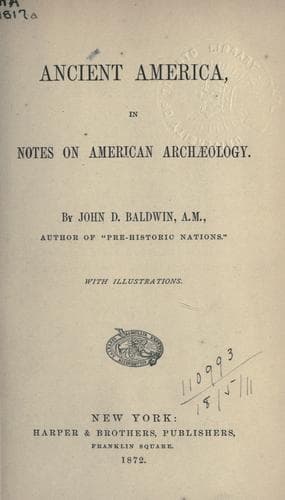
Ancient America, in Notes on American ArchaeologyBaldwin, John D. (John Denison)
History
Ancient America, in Notes on American Archaeology
Baldwin, John D. (John Denison)
America -- Antiquities; America -- Discovery and exploration -- Pre-Columbian; Indians -- Antiquities
Investigation has made it probable that the Mexicans or Aztecs went to
the Valley of Mexico from the south. Mr. Squier says: “The hypothesis of
a migration from Nicaragua and Cuscutlan to Anahuac is altogether more
consonant with probabilities and with tradition than that which derives
the Mexicans from the north; and it is a significant fact, that in the
map of their migrations presented by Gemelli, the place of the origin of
the Aztecs is designated by the sign of water (_atl_ standing for
Aztlan), a pyramidal temple with grades, and near these a palm-tree.”
Humboldt thought this indicated a southern origin.
Communities of Aztecs still exist as far south as Nicaragua and Costa
Rica, with some variations in their speech, but not so great, probably,
as to make them unintelligible to each other. The Spanish historian,
Oviedo, called attention to the fact that an isolated community of
Aztecs was found occupying the territory between Lake Nicaragua and the
Pacific. They were called Niquirans, and Mr. Squier seems to have
verified this fact. The result of his investigation is that the people
of the district specified are Aztecs, and that, “from the comparative
lateness of the separation or some other cause,” their distinguishing
features were easily recognized, their speech being nearly identical
with the native speech heard in the Valley of Mexico. Oviedo said of
them: “The Niquirans who speak the Mexican language have the same
manners and appearance as the people of New Spain (Mexico).” In the
neighboring districts, communities closely related to the Mayas are
found, and others that appear to belong to the Toltec family. Aztecs are
found still farther south, and there appear to be conclusive reasons for
believing that Montezuma’s people went from the south to Anahuac or
Mexico.
According to the native histories as reported by Clavigero, the Aztecs
began their migration northward from Aztlan about the year 1160 A.D.,
and founded the more important of their first settlements in the Valley
of Mexico about the year 1216 A.D., a little over three hundred years
previous to the Spanish invasion. Another result of investigation adds a
century to this estimate. This result is reached as follows: the
Mexicans stated constantly that their calendar was reformed some time
after they left Aztlan, and that in the year 1519 eight cycles of
fifty-two years each and thirteen years of a ninth cycle had passed
since that reform was made. This carries back the beginning of their
migration considerably beyond the year 1090 A.D.
Public-domain text, read in full here on John Shaqi.
Reviews
Reviews
No reviews yet
Be the first to share your thoughts on this work.
Elsewhere in the archive
Join the Discussion
Join the discussion
Sign in to leave a comment or review.
Sign InorCreate an account