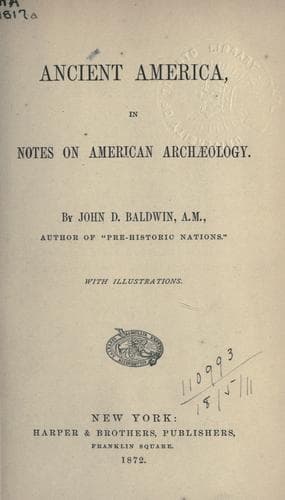
Ancient America, in Notes on American ArchaeologyBaldwin, John D. (John Denison)
History
Ancient America, in Notes on American Archaeology
Baldwin, John D. (John Denison)
America -- Antiquities; America -- Discovery and exploration -- Pre-Columbian; Indians -- Antiquities
It has been the fashion to depreciate Montesinos, but I find it
impossible to discover the reasons by which this depreciation can be
justified. It is alleged that he uses fanciful hypotheses to explain
Peru. The reply to this seems to me conclusive. In the first place, he
is, in this respect, like all other writers of his time. That was an age
of fanciful theories. Montesinos is certainly no worse than others in
this respect, while he has the merit of being somewhat more original. He
brought the Peruvian civilization from Armenia, and argued that Peru was
Solomon’s Ophir. Undue importance has been accorded to several of the
old Spanish chroniclers, whose works contain suggestions and fancies
much more irrational. In the second place, his theories have nothing
whatever to do with his facts, by which they are sometimes contradicted.
He found in Peru materials for the scheme of its ancient history, which
he sets forth. Readers will form their own estimates of its value, but
no reasonable critic will confound this part of his work with his
fanciful explanations, which are sometimes inconsistent with it. For
instance, his theory assumes that the first monarch of the old kingdom
began his reign as far back in the past as the year 2500 B.C. But he
reports only sixty-four rulers of that old kingdom. Now, if there were
so many as sixty-four, and if we allow an average of twenty years to
each reign (which is sufficient), we can not carry back the beginning of
that first reign to the year 1200 B.C.
There is another objection, which must be stated in the words of one of
the critics who have urged it: “Montesinos treats the ancient history of
Peru in a mode so original and distinct from all others that we can
perceive it to be a production alike novel and unknown.” If this means
any thing, it means that it was highly improper for Montesinos to find
in Peru what was “unknown” to poorly-informed and superficial Spanish
writers, who had already been accepted as “authorities.” It would have
been singular if his careful investigation, continued through fifteen
years, had not given him a great amount of information which others had
never taken pains to acquire. His treatment of the subject was “original
and distinct from all others,” because he knew what other writers did
not know. His information did not allow him to repeat the marvelous
story of Manco-Capac and Mama Oello, nor to confine Peruvian history to
the time of the Incas. But when the result of his inquiries was
announced in Europe, Garcilasso and others regulated the fashion of
Peruvian studies, and the influence of their limited and superficial
knowledge of the subject has been felt ever since.
Public-domain text, read in full here on John Shaqi.
Reviews
Reviews
No reviews yet
Be the first to share your thoughts on this work.
Elsewhere in the archive
Join the Discussion
Join the discussion
Sign in to leave a comment or review.
Sign InorCreate an account