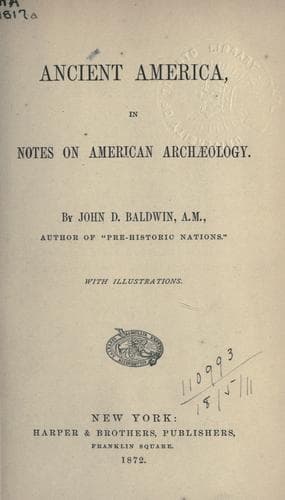
Ancient America, in Notes on American ArchaeologyBaldwin, John D. (John Denison)
History
Ancient America, in Notes on American Archaeology
Baldwin, John D. (John Denison)
America -- Antiquities; America -- Discovery and exploration -- Pre-Columbian; Indians -- Antiquities
The curious theories of Montesinos may be brushed aside as rubbish, or
be studied with other vagaries of that age in order to understand its
difference from ours; but whoever undertakes to criticise his facts
needs to be his equal in knowledge of Peru. His works, however, tell us
all that can ever be known of Peruvian ancient history, for the
facilities for investigation which existed in his time are no longer
possible. It may, however, be useful to consider that the main fact in
his report on the subject is no more “original and distinct” than the
testimony of the monuments around Lake Titicaca. The significance of
this testimony is now generally admitted. There _was_ a period in the
history of Peruvian civilization much earlier than that of the Incas, a
period still represented by these old monuments which, so far as relates
to this point, are as “novel” and “original” as Montesinos himself.
That the civilization found in the country was much older than the Incas
can be seen in what we know of their history. Their empire had grown to
be what Pizarro found it by subjugating and absorbing a considerable
number of small states, which had existed as civilized states before
their time. The conquest of Quito, which was not inferior to the Valley
of Cuzco in civilization, had just been completed when the Spaniards
arrived. The Chimus, subjugated a few years earlier, are described as
even more advanced in civilization than any other Peruvian community.
The small states thus absorbed by Peru were much alike in manners,
customs, manufactures, methods of building, and general culture. It is
manifest that their civilization had a common origin, and that to find
its origin we must go back into the past far beyond Inca-Rocco, the
first of his line, who began the work of uniting them under one
government.
Moreover, there were civilized communities in that part of the
continent which the Incas had not subjugated, such as the Muyscas on the
table-land of Bogota, north of Quito, who had a remarkable civil and
religious organization, a temple of the sun built with stone columns, a
regular system of computing time, a peculiar calendar, and who used
small circular gold plates as coin. They were described by Humboldt.
Public-domain text, read in full here on John Shaqi.
Reviews
Reviews
No reviews yet
Be the first to share your thoughts on this work.
Elsewhere in the archive
Join the Discussion
Join the discussion
Sign in to leave a comment or review.
Sign InorCreate an account