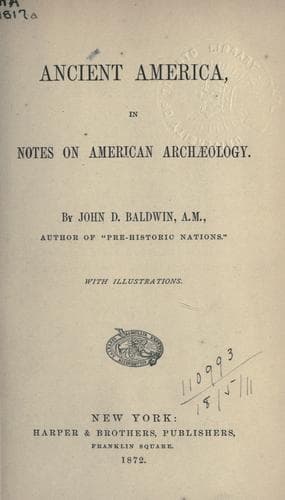
Ancient America, in Notes on American ArchaeologyBaldwin, John D. (John Denison)
History
Ancient America, in Notes on American Archaeology
Baldwin, John D. (John Denison)
America -- Antiquities; America -- Discovery and exploration -- Pre-Columbian; Indians -- Antiquities
If, as seems most likely, there was in South America an ancient
development of civilized human life, out of which arose the
civilizations found in Peru and Central America, its antiquity was much
greater than can be comprehended by the current chronologies. This,
however, can not make it improbable, for these chronologies are really
no more reasonable than the monkish fancies used in the sixteenth and
seventeenth centuries to explain these civilizations. We find the
hagiologists very absurd, but the condition of mind which made them
possible is closely akin to that which moves some men in our time to
deny or limit the past, and reject the results of any investigation
which tend to enlarge it. Rational inquiry constantly forces upon us the
suggestion that there was more in the unwritten history of the human
race than our inherited modes of thinking have allowed us to suppose,
and that the beginning of civilization is far more ancient than our long
accepted theories of antiquity are able to admit.
What may be discovered in South America by a more complete geological
and palæontological investigation it is not now possible to say.
Professor Orton, in his recent book, “The Andes and the Amazon,” far
exceeds Montesinos in his estimate of the antiquity of Peruvian
civilization. He says on this point:
“Geology and archæology are combining to prove that Sorato and
Chimborazo have looked down upon a civilization far more ancient than
that of the Incas, and perhaps coeval with the flint-flakes of Cornwall
and the shell-mounds of Denmark. On the shores of Lake Titicaca are
extensive ruins which antedate the advent of Manco-Capac, and may be as
venerable as the lake-dwellings of Geneva. Wilson has traced six
terraces in going up from the sea through the province of Esmeraldas
toward Quito, and underneath the living forest, which is older than the
Spanish invasion, many gold, copper, and stone vestiges of a lost
population were found. In all cases these relics are situated below the
high-tide mark, in a bed of marine sediment, from which he infers that
this part of the country formerly stood higher above the sea. If this be
true, vast must be the antiquity of these remains, for the upheaval and
subsidence of the coast is exceedingly slow.”--P. 109.
Public-domain text, read in full here on John Shaqi.
Reviews
Reviews
No reviews yet
Be the first to share your thoughts on this work.
Elsewhere in the archive
Join the Discussion
Join the discussion
Sign in to leave a comment or review.
Sign InorCreate an account