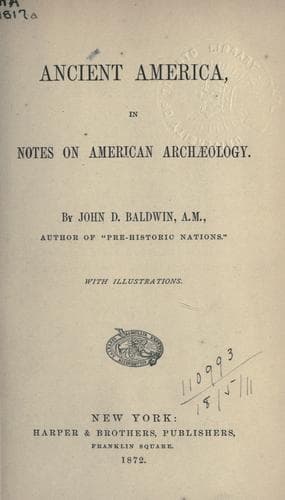
Ancient America, in Notes on American ArchaeologyBaldwin, John D. (John Denison)
History
Ancient America, in Notes on American Archaeology
Baldwin, John D. (John Denison)
America -- Antiquities; America -- Discovery and exploration -- Pre-Columbian; Indians -- Antiquities
The condition of the people composing the Peruvian empire at the time of
the Conquest bore witness to an ancient history something like that
reported by Montesinos. There were indications that the country had
undergone important revolutionary changes before this empire was
established. The Peruvians at that time were not all one people. The
political union was complete, but there were differences of speech, and,
to some extent, of physical characteristics. Three numerous and
important branches of the population were known as Aymaraes, Chinchas,
and Huancas. They used different tongues, although the Quichua dialect,
spoken by the Incas, and doubtless a dialect of the Aymaraes, to whom
the Incas belonged, was the official language in every part of the
empire. There was a separated and fragmentary condition of the
communities with respect to their unlike characteristics, which implied
something different from a quiet and uniform political history. These
differences and peculiarities suggest that there was a period when Peru,
after an important career of civilization and empire, was subjected to
great political changes brought about by invasion and revolution, by
which the nation was for a long time broken up into separate states.
Here, as in Mexico and Central America, there was in the traditions
frequent mention of strangers or foreigners who came by sea to the
Pacific coast and held intercourse with the people; but this was in the
time of the old kingdom. As the Malays and other island people under
their influence formerly traversed the Pacific, this is not improbable.
Some have assumed that the Peruvians had no communication with the
Mexicans and Central Americans, and that the two peoples were unknown to
each other. This, however, seems to be contradicted by the fact that an
accurate knowledge of Peru was found among the people inhabiting the
Isthmus and the region north of it. The Spaniards heard of Peru on the
Atlantic coast of South America, but on the Isthmus Balboa gained clear
information in regard to that country from natives who had evidently
seen it. To what extent there was intercourse between the two civilized
portions of the continent is unknown. They had vessels quite as good as
most of those constructed at Panama by the Spanish hunters for Peru,
such as the _balsas_ of the Peruvians and the “shallop” of the Mayas
seen by Columbus, which made communication possible up and down the
coast; but whether regular intercourse between them was ever
established, and every thing else relating to this matter, must
necessarily be left to a calculation of probabilities.
CONCLUSION.
Public-domain text, read in full here on John Shaqi.
Reviews
Reviews
No reviews yet
Be the first to share your thoughts on this work.
Elsewhere in the archive
Join the Discussion
Join the discussion
Sign in to leave a comment or review.
Sign InorCreate an account