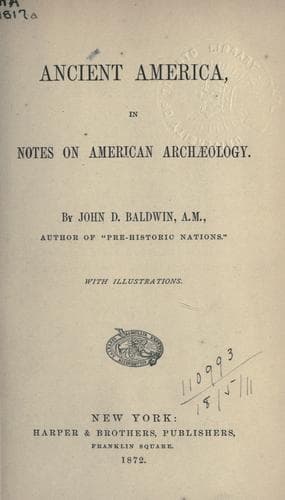
Ancient America, in Notes on American ArchaeologyBaldwin, John D. (John Denison)
History
Ancient America, in Notes on American Archaeology
Baldwin, John D. (John Denison)
America -- Antiquities; America -- Discovery and exploration -- Pre-Columbian; Indians -- Antiquities
“The hill is so regular in its outline that it appears like a work of
art, a giant effort of the Mound-Builders. Its general form resembles
very much the pyramid of Cholulu in Mexico, and from this fact I felt a
great interest in climbing it. We proceeded, Conway, Eldhardt, Kaiser,
and I, on foot up the grassy slope of the hill. There was an absence of
all volcanic matter; no stone on the hill except what had been brought
there by the hand of man. As we arrived near the summit we came upon
great square blocks of hewn stone overgrown by shrubbery, and on
reaching the summit we found that it had been leveled and squared
according to the cardinal points, and paved. We found two square blocks
of hewn stone imbedded in the earth in an upright position, some fifteen
feet apart, and ranging exactly east and west. Over the platform was
rank grass, and a grove of cocoanuts some hundred years old. Examining
farther, I found that the upper portion of the hill had been terraced;
the terraces near the summit could be distinctly traced, and they had
evidently been faced with hewn stone. The stones were in perfect squares
of not less than three feet in diameter, many of them of much greater
size. They were composed of a dark vitreous basalt, the most durable of
all stone. It is remarkable that every slab was faced and polished upon
every side, so that they could fit together like sheets of paper. They
reminded me much of the polished stones in some of the walls of
Tiahuanuco, and other ruins in Peru. Many of the blocks were lying
detached; probably some had been removed; but there were still some
thirty feet of the facing on the lower terrace partly in position. But
all showed the ravages of time and earthquakes, and were covered with
accumulated soil, grass, and shrubbery. Conway and myself, in descending
the hill, had our attention attracted by a direct line of shrubbery
running from the summit to the base of the hill, on the western side, to
the cocoanut grove below. Upon examination, we found it to be the
remains of a stairway, evidently of hewn stone, that had led from the
foot of the hill to the first terrace, a height of nearly 300 feet.
Within this stairway, near the base, we found a cocoanut-tree growing,
more than 200 years old, the roots pressing out the rocks. The site for
a temple is grand and imposing, and the view extensive, sweeping the
ocean, the mountains, and the great lava plain of Puna. It was also
excellent in a military point of view as a lookout. From the summit it
appeared as an ancient green island, around which had surged and rolled
a sea of lava; and so it evidently has been.
Public-domain text, read in full here on John Shaqi.
Reviews
Reviews
No reviews yet
Be the first to share your thoughts on this work.
Elsewhere in the archive
Join the Discussion
Join the discussion
Sign in to leave a comment or review.
Sign InorCreate an account