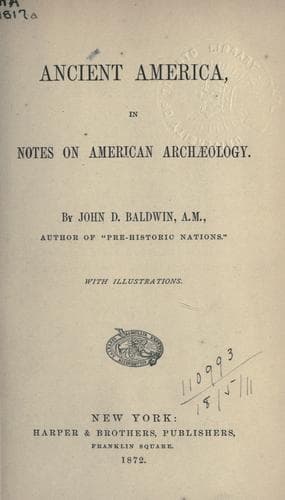
Ancient America, in Notes on American ArchaeologyBaldwin, John D. (John Denison)
History
Ancient America, in Notes on American Archaeology
Baldwin, John D. (John Denison)
America -- Antiquities; America -- Discovery and exploration -- Pre-Columbian; Indians -- Antiquities
“By whom and when was this hill terraced and these stones hewn? There is
a mystery hanging around this hill which exists nowhere else in the
Sandwich Islands. The other structures so numerously scattered over the
group are made of rough stone; there is no attempt at a terrace; there
is no flight of steps leading to them; there is no hewn or polished
stone, nor is there any evidence of the same architectural skill
evinced. They are the oldest ruins yet discovered, and were evidently
erected by a people considerably advanced in arts, acquainted with the
use of metallic instruments, the cardinal points, and some mathematical
knowledge. Were they the ancestors of the present Hawaiians, or of a
different race that has passed away?”
He inquired of the oldest natives concerning the history of this ruin,
but “they could give only vague and confused traditions in regard to it,
and these were contradictory. The only point on which they agreed was
that it had never been used within the memory of man.” They also said
there was another old structure of the same kind in Kona, whose history
is lost. The language of the Sandwich Islands is so manifestly a dialect
of the Malayan tongue, that the influence of the Malays must have been
paramount in these islands in ancient times.
D.
DECIPHERING THE INSCRIPTIONS.
In the “Actes de la Société Philologique,” Paris, for March, 1870, Mons.
H. de Charencey gives some particulars of his attempt to decipher
“fragments” of one or two very brief inscriptions on the bas-relief of
the cross at Palenque. I know nothing of his qualifications for this
work, but he appears to have studied the characters of the Maya
alphabet preserved and explained by Landa. It is seen, however, that his
attempt to decipher the inscriptions is a complete failure. In fact, he
professes to have done no more than reproduce two or three words in
Roman characters. He gives us _Hunab-ku_, _Eznab_, and _Kukulcan_ as
words found on the cross. _Eznab_ is supposed to be the name of a month,
or of a day of the week, and the others names of divinities. He finds
that the characters of the inscriptions are not in all respects
identical with those found in Landa, and that Landa’s list, especially
when tested by the inscriptions, is incomplete. There is not absolute
certainty in regard to the name Kukulcan; nevertheless, M. de Charencey
makes this speculative use of it:
“The presence of the name ‘Kukulcan’ on the bas-relief of the cross is
important in a historical point of view. The name of this demigod, which
signifies ‘the serpent with the quetzal plumes,’ is the Maya form of the
Mexican name ‘Quetzalcohuatl,’ which has precisely the same meaning. But
we know that the name and worship of this god were brought to the high
plateaus of Central America toward the ninth century of our era,
consequently the bas-relief in question can not be more ancient.”
Public-domain text, read in full here on John Shaqi.
Reviews
Reviews
No reviews yet
Be the first to share your thoughts on this work.
Elsewhere in the archive
Join the Discussion
Join the discussion
Sign in to leave a comment or review.
Sign InorCreate an account