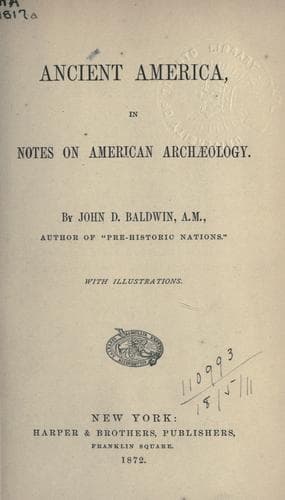
Ancient America, in Notes on American ArchaeologyBaldwin, John D. (John Denison)
History
Ancient America, in Notes on American Archaeology
Baldwin, John D. (John Denison)
America -- Antiquities; America -- Discovery and exploration -- Pre-Columbian; Indians -- Antiquities
Brasseur de Bourbourg on the antiquity of the Mound-Builders, 53;
on their Mexican origin, 57;
on their religion, 53;
on the Chichimecs, 198;
on Huehue Tlapalan, 201;
on Nahuatl chronology, 204;
his “Atlantic theory,” 159, 160, 174-83;
he has great knowledge of American traditions and antiquities, 174;
discovered the works of Ximenes and Landa’s Maya alphabet, 191, 192;
translated “Popol-Vuh,” 192;
he is unsystematic, confused, and fanciful, 102, 160.
Brereton on the wild Indians of New England, 62-5;
his invented stories of their copper and flax, 62, 63.
Calendars in Mexico, 214-15;
in Peru, 236.
Central American and Southern Mexican ruins most important, 93;
their masonry and ornamentation, 99-101;
a great forest covers most of them, 94, 103, 104;
a road built into the forest in 1695, 95, 151-2;
this forest covers a chief seat of the ancient civilization, 95;
Cinaca-Mecallo, 124.
Cevola, “Seven Cities” of, 85-9.
Charencey, M. de, attempts to decipher an inscription, 292-3;
his singular speculation concerning the worship of Kukulcan, 293.
Charnay, Desiré, his account of Mitla, 121, 122.
Chronology of the Mexican race, 203-4;
of the Peruvians, 265-6.
Civilization, antiquity of, underrated, 181-2, 273.
Cloth of Mound-Builders, fragments of, 41.
Coin among the Muyscas, 271.
“Coliseum” at Copan, 114.
Columbus and the Mayas, 209-10.
Copan, its ruins situated in wild region, 111;
first discovered in 1576, and were then mysterious to the natives,
93, 111;
what Mr. Stephens saw there, 111, 112;
what Palacios found there 300 years ago, 113, 114;
the inscriptions, monoliths, and decorations, 112;
seems older than Palenque, 112, 113, 155.
Copper of Lake Superior described, 43.
Coronado’s conquest of “Cevola,” 85, 86.
Cortez invades Mexico, 210;
his progress, 210-11;
well received at the city of Mexico, 211;
driven from the city, 213;
how the city was taken, 213-14;
it was immediately rebuilt, 214;
the plaza made of part of the inclosure of the great temple, 214;
Cortez could not have invented the temple, 215.
Cross, the, not originally a Christian emblem, 109;
vastly older than Christianity as a symbolic device, 109, 110;
common in Central American ruins, 109;
the assumption that it was first used as a Christian emblem has
misled inquiry as to the age and origin of antiquities, 110.
Cuzco, Montesinos on its name, 227;
was probably built by the Incas on the site of a ruined city of the
older times, 226-7;
the ruins at Cuzco, 226, 234-5.
Egyptian pyramids totally unlike those in America, 183;
no resemblance between Egyptians and the Mexican race, 183.
Ethnology, American, discussed, 65-9;
South Americans the oldest aborigines, 68, 69, 185;
Huxley’s suggestion, 69.
Gallatin, Albert, on Mound-Builders, 34.
Public-domain text, read in full here on John Shaqi.
Reviews
Reviews
No reviews yet
Be the first to share your thoughts on this work.
Elsewhere in the archive
Join the Discussion
Join the discussion
Sign in to leave a comment or review.
Sign InorCreate an account