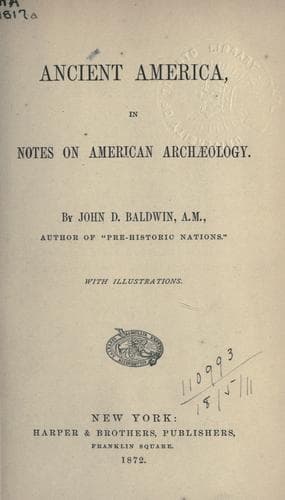
Ancient America, in Notes on American ArchaeologyBaldwin, John D. (John Denison)
History
Ancient America, in Notes on American Archaeology
Baldwin, John D. (John Denison)
America -- Antiquities; America -- Discovery and exploration -- Pre-Columbian; Indians -- Antiquities
Antiquity of the Mexican and Central American ruins, 151-59, 184;
the great forest was 450 years ago what it is now, 151;
it covers an ancient seat of civilization, 95, 151, 152;
Copan forgotten and mysterious before the Conquest, 152;
there was a long period of history preceded by development of the
civilization, 152, 153;
distinct epochs traced, 155, 156;
no perishable materials left in the ruins, 156-159;
an extreme notion of their antiquity, 157, 158, 207;
another notion makes this the “oldest civilization in the world,”
159-61;
Tyrians saw the old cities 3000 years ago, 162-64.
Antiquity of the Mound-Builders, 45-51;
a new river terrace formed since they left, 47;
decayed condition of their skeletons shows antiquity, 48-9;
“primeval” forests found growing over their works, 50-1.
Astronomical monument in Southern Mexico, 122-3;
at Chapultepec, 220-1;
in Peru, 254;
Mexican calendars, 214-15;
Peruvian calendars, 236. See Telescopic Tubes.
Atlantis supposed to be an ingulfed part of America, 175-7;
its destruction recorded in Egypt and related to Solon, 177-8;
said to be recorded in old Central American books, 176;
Proclus on remembrance of Atlantis, 178;
derivation of the words Atlas, Atlantes, and Atlantic, 179;
opinions relative to former existence of such land, 180-1;
geological probabilities, 181;
memory of war with the Atlantes preserved at Athens, 178.
Aztec civilization denied in a “New History,” 207-8;
facts discredit this denial, 208-9;
Cortez found abundant supplies, 208, 210;
found Mexican mechanics, masons, and the like, 213, 214, 215;
the city of Mexico and its great temple, realities, 208, 212, 215;
both described, 211-12;
present remains of them, 214-15.
Aztecs, the, were less civilized than their predecessors, 221;
they came from the south, 217-18;
when they left Aztlan, 219;
how long they had been in Mexico, 219;
what they learned and borrowed of their neighbors, 220-1;
did not adopt the phonetic system of writing, 221;
could not have left such ruined cities as Palenque and Mitla, 221;
Aztecs still found at the south, 218-19.
Balboa’s hunt for Peru, 223-4.
Basques, their fishing voyages to America, 62.
Books of ancient America destroyed in Mexico and Central America by
the Aztec Ytzcoatl, 189;
by Spanish fanaticism, 188-9;
a few of the later books saved, 180-196;
some of the more important, 195-6;
books of hieroglyphics in Peru, 256.
Boturini collected Mexican and Central American books, 195;
misfortunes of his collection, 195-6.
Public-domain text, read in full here on John Shaqi.
Reviews
Reviews
No reviews yet
Be the first to share your thoughts on this work.
Elsewhere in the archive
Join the Discussion
Join the discussion
Sign in to leave a comment or review.
Sign InorCreate an account