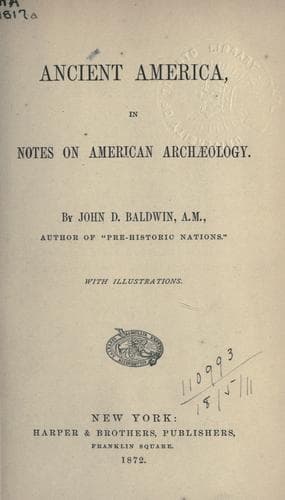
Ancient America, in Notes on American ArchaeologyBaldwin, John D. (John Denison)
History
Ancient America, in Notes on American Archaeology
Baldwin, John D. (John Denison)
America -- Antiquities; America -- Discovery and exploration -- Pre-Columbian; Indians -- Antiquities
Malays, their ancient empire, 167-8;
their navigation of the Pacific, 168;
spread of their dialects, 168;
came to America, 169, 170, 272;
El Masúdí[TN-8] on the Malays, 168;
were not civilizers in America, 170-1;
ruins of Malayan cities in Java, 163-9.
Manco-Capac a fiction of the Incas, 260-1;
discarded by Montesinos and other early Spanish writers, 261, 269.
Mandan Indians supposed Mound-Builders, 74.
Mayas first seen by Columbus, 209;
their phonetic alphabet preserved, 191;
descendants of the first civilizers, 170.
Mexican cities noticed by Spaniards, 211, 215;
what Montezuma said of his building materials, 209.
Mexican “picture-writing” a peculiarity of the Aztecs, 221;
much inferior to the Maya writing, 221;
something like it at Chichen-Itza, 143;
Aztecs could not have left such inscriptions as those seen in the
ruined cities, 221.
Mexican ruins in the central region, 89-92;
Tulha, 89;
Xochicalco, 89, 90;
Papantla, 91, 92;
Cholula, 90;
Teotihuacan, 90;
pyramids with galleries, 91;
unexplored antiquities in this region, 91.
Mining works of Mound-Builders, 43-6;
mining method of the Mound-Builders, 43;
their mining tools found, 44, 46;
they left a detached mass of copper in a mine, 43-4;
antiquity of their mining works, 46, 53, 64.
Mitla, its ruins show refined skill in the builders, 118, 121;
the decorations, 121;
present state of the ruins, 117-122.
Montesinos, Fernando, explored and studied Peru fifteen years, 261;
unequaled in knowledge of its antiquities and traditional history,
263;
his means of information, 262;
how historical narratives and poems were preserved by the _amautas_, 263;
how literature can be preserved by trained memory, 262-3;
Homer and the Vedas, 262-3.
Montesinos on Peruvian history, 264-7;
there were three distinct periods, 264;
he rejects the Manco-Capac fable, 264;
does not begin the history with such stories, 264;
reports 64 kings in the first period, 264;
his account of the Peruvian sovereigns, 264-7;
the art of writing existed in the older time, 265;
how the first period closed, 266;
the second period, for 1000 years, a period of invasions, divisions,
small states, and general decline of civilization, 264, 267;
in this period the art of writing was lost, 267;
in it the 26 successors of the 64 kings were merely kings of
Tambotoco, 266;
how this period ended, 267-8;
the third period began with Rocca, the first Inca, 267;
why Montesinos has not been duly appreciated, 268-9;
his facts stand apart from his theories, 268;
probabilities favor his report of three periods, 270-1.
Montezuma on his building-material, 209.
Morgan, Lewis H., on the Indians, 59, 60, 66.
Public-domain text, read in full here on John Shaqi.
Reviews
Reviews
No reviews yet
Be the first to share your thoughts on this work.
Elsewhere in the archive
Join the Discussion
Join the discussion
Sign in to leave a comment or review.
Sign InorCreate an account