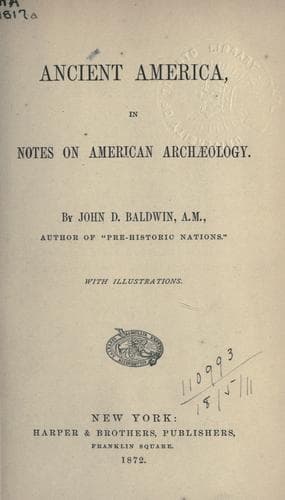
Ancient America, in Notes on American ArchaeologyBaldwin, John D. (John Denison)
History
Ancient America, in Notes on American Archaeology
Baldwin, John D. (John Denison)
America -- Antiquities; America -- Discovery and exploration -- Pre-Columbian; Indians -- Antiquities
Peruvian ruins, where found, 222, 237;
they represent two periods of civilization, 226;
remains on islands in Lake Titicaca, 227-8;
at Tiahuanaco, 233-4;
remarkable monolithic gateways, 233-4;
at old Huanuco, 239-40;
at Gran-Chimu, 237-8;
ruins of a large and populous city, 237;
Cuelap, 239;
Pachacamac, 243;
subterranean passage under a river, 243;
the aqueducts, 222, 237, 243;
the great roads, 243-6;
ruins at Cuzco, 234.
Phœnicians, or people of that race, came probably to America in very
ancient times, 172, 173;
decline of geographical knowledge around the Ægean after Phœnicia
was subjugated, about B.C. 813, 272-3;
supposed Phœnician symbols in Central America, 186;
Phœnician race may have influenced Central American civilization,
but did not originate it, 173, 185;
Tyrians storm-driven to America, 162, 163.
Pizarro seeks Peru, 224-5;
discovers the country, 225;
goes to Spain for aid, 225;
finally lands at Tumbez, 225;
marches to Caxamalca, 220;
perpetrates wholesale murder and seizes the Inca, 220;
the Inca fills a room with gold for ransom, and is murdered, 220, 249.
“Popol-Vuh,” an old Quiché book translated, 192;
what it contains, 193;
Quiché account of the creation, 194;
four attempts to create man, 194-5;
its mythology grew out of an older system, 193-4;
kingdom of Quiché not older than 1200 A.D., 193.
Pueblos, 76, 77;
Pueblo ruins, 77-89;
occupied northern frontier of the Mexican race, 68, 217-18;
unlike the wild Indians, 67-8.
Quichés, notices of, 193.
Quippus, Peruvian, 254-5.
Quirigua, its ruins like those of Copan, but older, 114;
it is greatly decayed, 117;
has inscriptions, 117.
Quito subjugated by Huayna-Capac, 225;
was civilized like Peru, 270;
modern traveler’s remark on, 276.
Savage theory of human history, 182.
“Semi-Village Indians,” 67, 68.
Serpent, figures of, 28;
great serpent inclosure, 28.
Simpson, Lieut., describes a Pueblo ruin, 88, 89.
Spinning and weaving in Peru, 247;
vestiges of these arts among the Mound-Builders, 41;
the Mayas had textile fabrics, 209.
Squier on the Aztecs, 92;
on the more southern ruins in Central America, 123, 124;
on the monoliths of Copan, 112;
on Central American forests, 94;
on the ruins of Tiahuanaco, 234.
Telescopic tubes of the Mound-Builders, 42;
silver figure of a Peruvian using such a tube, 254;
such a tube on a Mexican monument, 123.
“Tennis Court” at Chichen-Itza, 142.
Titicaca Lake, its elevation above sea-level, 236.
Tlascalans, what Cortez found among them, 210;
their capital, 211;
aided the Spaniards, 211.
Toltecs identified with the Mound-Builders, 201-205;
how they came to Mexico, 201, 202;
date of their migration, 204. See Huehue Tlapalan.
Tuloom, in Yucatan, 150.
Public-domain text, read in full here on John Shaqi.
Reviews
Reviews
No reviews yet
Be the first to share your thoughts on this work.
Elsewhere in the archive
Join the Discussion
Join the discussion
Sign in to leave a comment or review.
Sign InorCreate an account