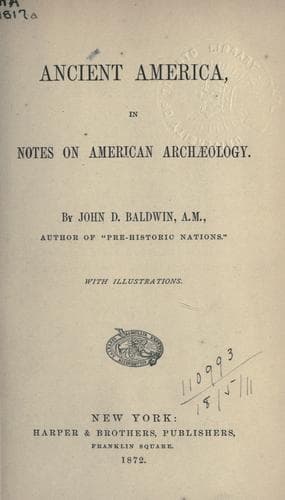
Ancient America, in Notes on American ArchaeologyBaldwin, John D. (John Denison)
History
Ancient America, in Notes on American Archaeology
Baldwin, John D. (John Denison)
America -- Antiquities; America -- Discovery and exploration -- Pre-Columbian; Indians -- Antiquities
1. One fact showing this is pointed out by those who have examined them
carefully as follows: None of these works (mounds and inclosures) occur
on the lowest-formed of the river terraces, which mark the subsidence of
the western streams; and as there is no good reason why their builders
should have avoided erecting them on that terrace, while they raised
them promiscuously on all the others, it follows, not unreasonably, that
this terrace has been formed since the works were erected. It is
apparent, also, that in some cases the works were long ago partly
destroyed by streams which have since receded more than half a mile, and
at present could not reach them under any circumstances. Those streams
generally show four successive terraces, which mark four distinct eras
of their subsidence since they began to flow in their present courses.
The fourth terrace, on which none of the works are found, marks the
last and longest of these periods; and it marks also the time since the
Mound-Builders ceased to occupy the river-valleys where it was formed.
The period marked by this fourth terrace must be the longest, because
the excavating power of such streams necessarily diminishes as their
channels grow deeper. This geological change, which has taken place
since the latest of the mounds and inclosures were constructed, shows
that the works are very old; no one can tell how old. To count the years
is impossible; but we can see that the date, if found, would take us
back to a remote period in the past.
2. Great antiquity is indicated by the skeletons taken from the mounds.
Every skeleton of a Mound-Builder is found in a condition of extreme
decay. It sometimes appears that the surface of a mound has been used by
the wild Indians for interments; but their skeletons, which are always
found well preserved, can be readily distinguished by their position in
the mounds, as well as by other peculiarities. The decayed bones of
Mound-Builders are invariably found within the mounds, never on the
surface, usually at the bottom of the structure, and nearly always “in
such a state of decay as to render all attempts to restore the skull,
or, indeed, any part of the skeleton, entirely hopeless.” Not more than
one or two skeletons of that people have been recovered in a condition
suitable for intelligent examination. It is stated in the work of Squier
and Davis that the only skull belonging incontestably to an individual
of the Mound-Building race, which has been preserved entire, was taken
from a mound situated on a knoll (itself artificial apparently) on the
summit of a hill, in the Scioto Valley, four miles below Chillicothe.
Public-domain text, read in full here on John Shaqi.
Reviews
Reviews
No reviews yet
Be the first to share your thoughts on this work.
Join the Discussion
Join the discussion
Sign in to leave a comment or review.
Sign InorCreate an account