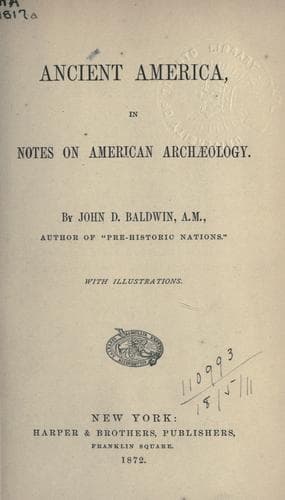
Ancient America, in Notes on American ArchaeologyBaldwin, John D. (John Denison)
History
Ancient America, in Notes on American Archaeology
Baldwin, John D. (John Denison)
America -- Antiquities; America -- Discovery and exploration -- Pre-Columbian; Indians -- Antiquities
“They had great store of copper, some very red, some of a paler color;
none of them but have chains, earrings, or collars of this metal. They
had some of their arrows herewith, much like our broad arrow-heads,
very workmanly made. Their chains are many hollow pieces cemented
together, each piece of the bigness of one of our reeds, a finger in
length, ten or twelve of them together on a string, which they wear
about their necks: their collars they wear about their bodies like
bandeliers a handful broad, all hollow pieces like the other, but
somewhat shorter, four hundred pieces in a collar, very fine and evenly
set together.” He adds: “I am persuaded they have great store (of flax)
growing upon the main, as also mines and many other rich commodities,
which we, wanting time, could not possibly discover.”
If all this had been true, it would not serve the purpose for which it
is quoted; for remains of the Mound-Builders have never existed in
Massachusetts, and we should necessarily suppose these Indians had
procured copper and copper ornaments by trading with the Basques or with
other French voyagers. If only one or two Indians had been represented
as wearing ornaments made of copper, this explanation could be readily
accepted. But he avers that they had “great store of copper,” and adds,
“None of them but have chains, earrings, or collars of this metal.”
Therefore his statement is incredible. The following considerations will
show why it must not be regarded as honest, unadorned truth.
1. Those interested in Gosnold’s voyage aimed to establish a colony on
that coast; and all who served them, or were controlled by them, were
easily moved to tell seductive stories of the country “upon the main.”
The chief aim of Brereton’s account of this voyage was to incite
emigration. Therefore he gave this wonderfully colored account of
mines, flax-growing, copper chains and collars, and “other rich
commodities” among the wild Indians of Massachusetts. Settlements on
that coast, it was believed, would bring profit to those in whose
interest he wrote. Gosnold actually proposed at that time to establish a
colony on one of the islands in Buzzard’s Bay, and had with him twenty
men who were expected to stay as colonists, but finally refused to do
so. He saw a great deal of the Indians, and knew much more of their
actual condition than the story admits.
Public-domain text, read in full here on John Shaqi.
Reviews
Reviews
No reviews yet
Be the first to share your thoughts on this work.
Join the Discussion
Join the discussion
Sign in to leave a comment or review.
Sign InorCreate an account