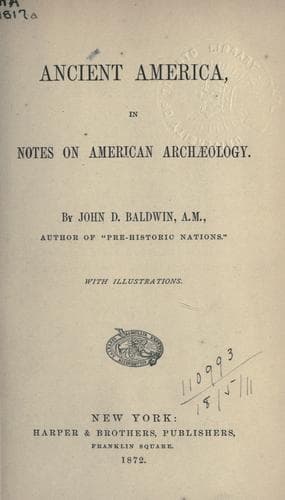
Ancient America, in Notes on American ArchaeologyBaldwin, John D. (John Denison)
History
Ancient America, in Notes on American Archaeology
Baldwin, John D. (John Denison)
America -- Antiquities; America -- Discovery and exploration -- Pre-Columbian; Indians -- Antiquities
Professor Huxley called attention to this subject in a brief address to
the London Ethnological Society in 1869. After stating the case, he
presented the following queries and suggestions: “The Austro-Columbian
fauna, as a whole, therefore, existed antecedently to the glacial epoch.
Did man form part of that fauna? To this profoundly interesting question
no positive answer can be given; but the discovery of human remains
associated with extinct animals in the caves of Brazil, by Lund, lends
some color to the supposition. Assuming this supposition to be correct,
we should have to look in the human population of America, as in the
fauna generally, for an indigenous or Austro-Columbian element, and an
immigrant or ‘Arctogeal’ element.” He then suggests that the Esquimaux
may now represent the immigrant element, and the old Mexican and South
American race that which was indigenous, and that the “Red Indians of
North America” may have appeared originally as a mixture of these two
races. He adds, very reasonably, “It is easy to suggest such problems as
these, but quite impossible, in the present state of our knowledge, to
solve them.”
WHO WERE THE MOUND-BUILDERS?
They were unquestionably American aborigines, and not immigrants from
another continent. That appears to me the most reasonable suggestion
which assumes that the Mound-Builders came originally from Mexico and
Central America. It explains many facts connected with their remains. In
the Great Valley their most populous settlements were at the south.
Coming from Mexico and Central America, they would begin their
settlements on the Gulf coast, and afterward advance gradually up the
river to the Ohio Valley. It seems evident that they came by this route;
and their remains show that their only connection with the coast was at
the south. Their settlements did not reach the coast at any other point.
Public-domain text, read in full here on John Shaqi.
Reviews
Reviews
No reviews yet
Be the first to share your thoughts on this work.
Join the Discussion
Join the discussion
Sign in to leave a comment or review.
Sign InorCreate an account