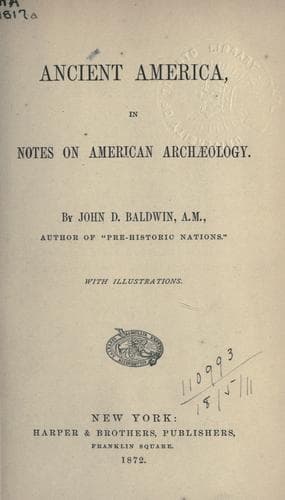
Ancient America, in Notes on American Archaeology — John Shaqi
Ancient America, in Notes on American ArchaeologyBaldwin, John D. (John Denison)
History
Ancient America, in Notes on American Archaeology
Baldwin, John D. (John Denison)
America -- Antiquities; America -- Discovery and exploration -- Pre-Columbian; Indians -- Antiquities
The ruins known as Palenque, for instance, seem to have been entirely
unknown to both natives and Spaniards until about the year 1750. Cortez
and some of his companions went through the open region near the forest
in which these ruins are situated without hearing of them or suspecting
their existence. The great ruins known as Copan were in like manner
unknown in the time of Cortez. The Spaniards assaulted and captured a
native town not far from the forest that covered them, but heard nothing
of the ruins. The captured town, called Copan, afterward gave its name
to the remains of this nameless ancient city, which were first
discovered in 1576, and described by the Spanish licentiate Palacios.
This was little more than forty years after the native town was
captured; but, although Palacios tried, “in all possible ways,” to get
from the older and more intelligent natives some account of the origin
and history of the ruined city, they could tell him nothing about it.
To them the ruins were entirely mythical and mysterious. With the facts
so accessible, and the antiquity of the ruins so manifest, it is very
singular that Mr. Stephens fell into the mistake of confounding this
ruined city, situated in an old forest that was almost impenetrable,
with the town captured by the Spaniards. The ruins here were discovered
accidentally; and to approach them it was necessary, as at Palenque, to
cut paths through the dense tropical undergrowth of the forest.
To understand the situation of most of the old ruins in Central America,
one must know something of the wild condition of the country. Mr. Squier
says:
“By far the greater proportion of the country is in its primeval state,
and covered with dense, tangled, and almost impenetrable tropical
forests, rendering fruitless all attempts at systematic investigation.
There are vast tracts untrodden by human feet, or traversed only by
Indians who have a superstitious reverence for the moss-covered and
crumbling monuments hidden in the depths of the wilderness. * * * For
these and other reasons, it will be long before the treasures of the
past, in Central America, can become fully known.”
A great forest of this character covers the southern-half of Yucatan,
and extends far into Guatemala, which is half covered by it. It extends
also into Chiapa and Tabasco, and reaches into Honduras. The ruins known
as Copan and Palenque are in this forest, not far from its southern
edge. Its vast depths have never been much explored. There are ruins in
it which none but wandering natives have ever seen, and some, perhaps,
which no human foot has approached for ages. It is believed that ruins
exist in nearly every part of this vast wilderness.
Public-domain text, read in full here on John Shaqi.
Reviews
Reviews
No reviews yet
Be the first to share your thoughts on this work.
Join the Discussion
Join the discussion
Sign in to leave a comment or review.
Sign InorCreate an account