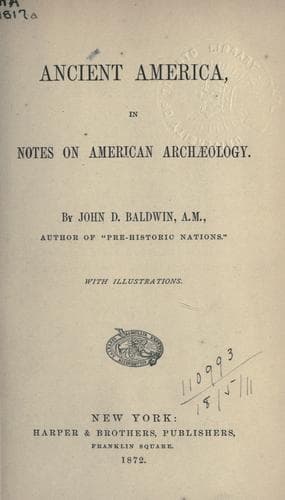
Ancient America, in Notes on American ArchaeologyBaldwin, John D. (John Denison)
History
Ancient America, in Notes on American Archaeology
Baldwin, John D. (John Denison)
America -- Antiquities; America -- Discovery and exploration -- Pre-Columbian; Indians -- Antiquities
Another circumstance mentioned is not without significance. It is said,
in connection with this account of the Toltec migration, that
Huehue-Tlapalan was successfully invaded by Chichimecs, meaning
barbarous aboriginal tribes, who were united under one great leader.
Here is one statement (a little condensed) touching this point: “There
was a terrible struggle, but, after about thirteen years, the Toltecs,
no longer able to resist successfully, were obliged to abandon their
country to escape complete subjugation. Two chiefs guided the march of
the emigrating nation. At length they reached a region near the sea
named ‘Tlapalan-Conco,’ where they remained several years. But they
finally undertook another migration and reached Mexico, where they built
a town called ‘Tollanzinco,’ and later the city of Tullan, which became
the seat of their government.”
This is substantially what is told of the defeat and migrations of the
Toltecs. The history of Ixtlilxochitl adds doubtful modifications and
particulars not found in the “Codex Chimalpopoca.” (See Quatre Lettres,
etc.) This Chichimec invasion of Huehue-Tlapalan is placed at a period
which, in the chronology of the native books, was long previous to the
Christian era, and is mentioned to explain the beginning of the Toltec
movement toward Mexico; but the account of it is obscure.
To find a system of chronology in these old books is not surprising when
we consider that even the Aztecs of Montezuma’s time knew enough of
astronomy to have a correct measure of the year. The Aztecs adopted the
methods of astronomy and chronology which were used by their
predecessors. They divided the year into eighteen months of twenty days
each; but, as this gave the year only three hundred and sixty days, five
supplementary days were added to each year, and a sixth day to every
fourth year. The bissextile is known to have been used by the Mayas,
Tzendals, and Quichés, and it was probably common.
Public-domain text, read in full here on John Shaqi.
Reviews
Reviews
No reviews yet
Be the first to share your thoughts on this work.
Elsewhere in the archive
Join the Discussion
Join the discussion
Sign in to leave a comment or review.
Sign InorCreate an account